Guide · General
Best CRM for Real Estate Agents: 2026 Comparison
Compare the best CRM for real estate agents in 2026 by lead management, workflows, integrations, usability and price, with dated pricing and sourced facts.
By the KeenVerdict research desk · Updated November 29, 2026 · 14 min read

A real estate CRM can collect strong reviews and still sit unused. Many brokerages report low CRM adoption, so daily usability is a practical selection criterion, ahead of a long feature list.
Follow Up Boss is the shortlist choice for teams that already have lead sources and need organized routing and follow-up. Wise Agent fits contact management next to transaction organization. Real Geeks is a different purchase: an IDX website and a CRM sold together. The best CRM for a given agent or team depends on the immediate problem: lead assignment, transaction tracking, or an integrated website workflow.
KeenVerdict's published method weights features at 40%, ease of use at 30%, and value at 30%. This ranking applies those weights to documented workflow fit, not to hands-on testing. Numerical product scores are not assigned, because the available evidence does not support comparable usability or total-cost measurements.
Prices should come from vendor pages, with the date they were checked. No independently checked vendor prices or check dates are available for this comparison, so no subscription amounts are presented as current offers. Value judgments below stay conditional on plan inclusions and a complete quote.
Table of Contents
- 1. Follow Up Boss
- 2. Wise Agent
- 3. RealOffice360
- 4. Top Producer
- 5. Real Geeks
- 6. Lofty
- 7. BoldTrail
- Real estate CRMs side by side
- How to Pick Your Real Estate CRM
1. Follow Up Boss
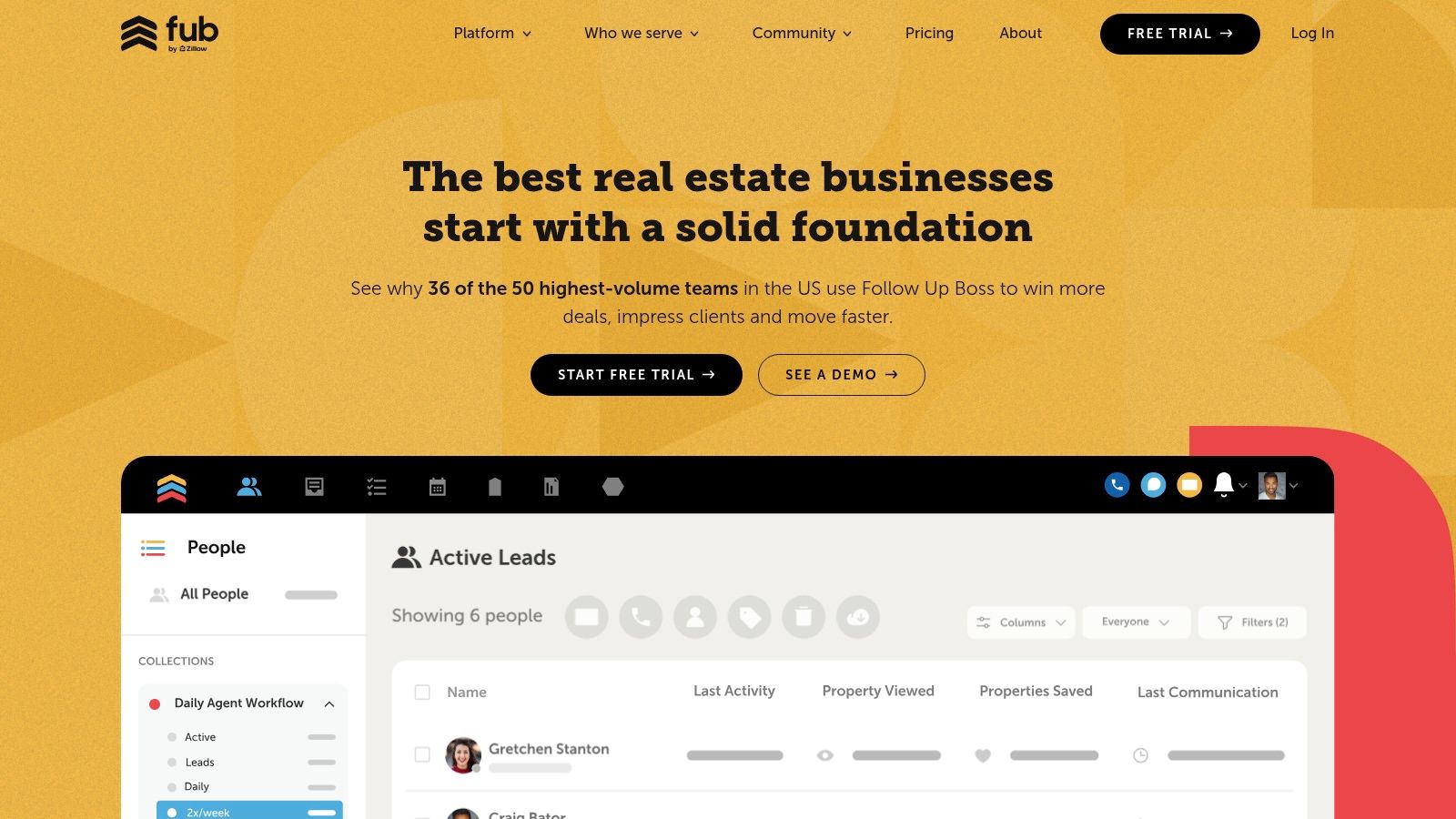
Best fit: agents and teams that want to keep their existing website and lead-generation tools. Follow Up Boss ranks first for a focused operating model: collect inquiries, assign responsibility, and make the next follow-up visible.
Follow Up Boss describes a dedicated real estate CRM with lead capture, routing, assignment rules, notifications, Smart Lists, automated follow-up, email and calendar synchronization, mobile access, and team collaboration. Its open-platform approach makes it relevant when replacing every marketing tool would create unnecessary disruption.
The important distinction is lead management rather than lead supply. A team can retain its website and advertising relationships while using the CRM as its shared record of conversations and next actions.
Where the focused approach pays off
Consider a team receiving website inquiries, portal leads, and referrals. The useful demonstration isn't a dashboard tour. It's whether each inquiry reaches the appropriate agent, retains its source information, and appears in a follow-up queue without manual copying.
- Feature fit: Routing and shared follow-up address an operational problem that a contact database alone doesn't solve.
- Ease-of-use question: Can agents identify their next action and record the outcome from a mobile device?
- Value qualification: Existing website and marketing expenses remain part of the overall budget.
Practical rule: A CRM that manages leads shouldn't receive credit for generating leads unless the purchased package actually includes that service.
The trade-off is straightforward: Follow Up Boss doesn't replace a website builder or lead service. Calling is an add-on on Grow, so a calling-heavy team needs a plan-specific cost calculation. The vendor also advertises trial access and monthly plans without a contract, but buyers should confirm the applicable terms before moving live workflows.
2. Wise Agent
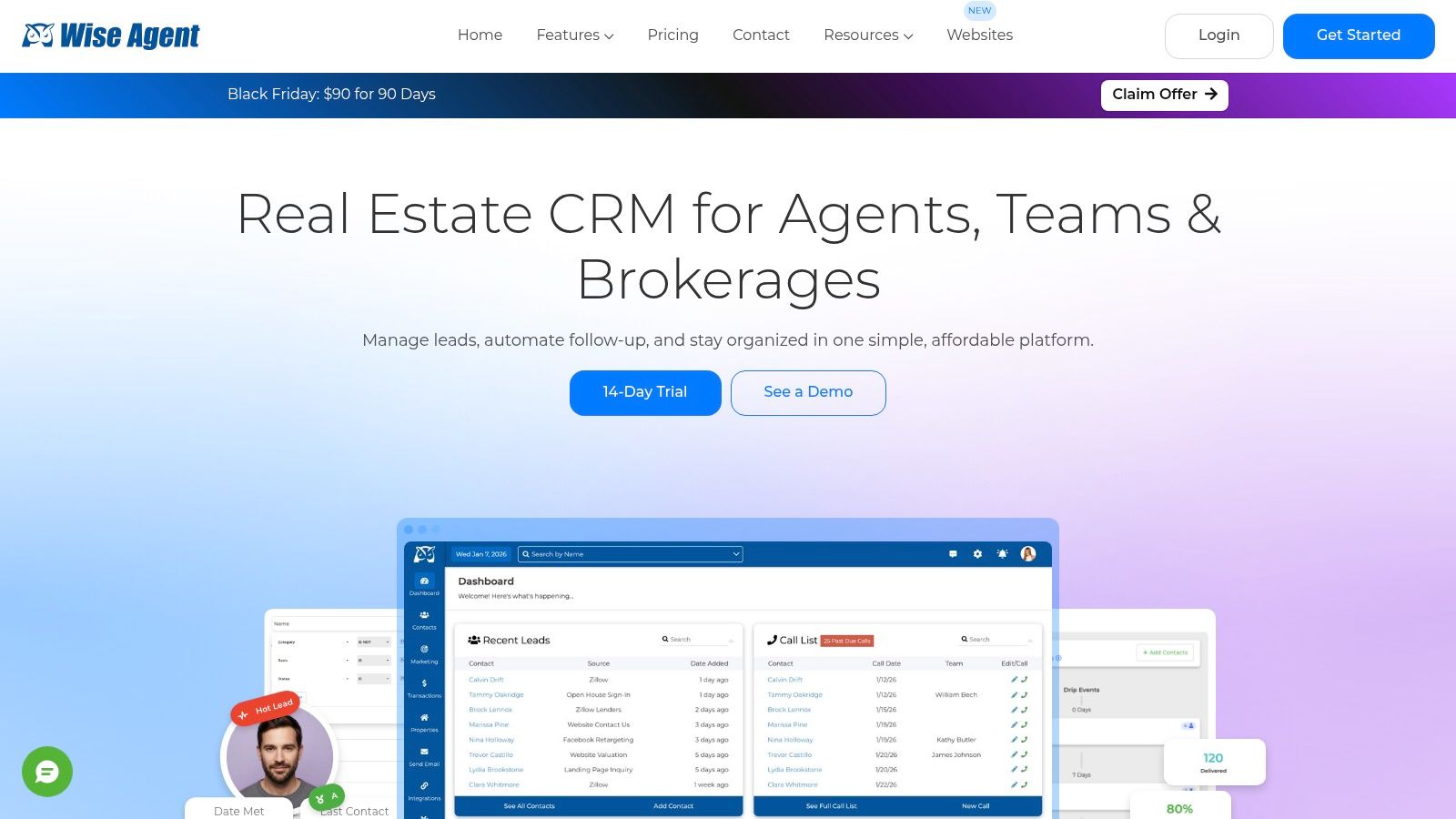
A small team may need fewer handoffs between contact management, marketing, and transaction preparation rather than more advanced routing. Wise Agent is the shortlist choice for that broader administrative workflow.
Wise Agent combines contact and lead management with drip campaigns, transaction management, calendars, reporting, landing pages, marketing tools, and document storage. The vendor also describes included onboarding, training, and live support, with optional texting, social-media automation, and additional user access.
Its flat-rate structure deserves attention, but included team access isn't necessarily equivalent to separate user accounts. The shared-login arrangement needs examination before a team treats it as a direct substitute for individually licensed seats.
Evaluate access before comparing value
For an agent working with an assistant, shared access may appear convenient. For a team that needs individual accountability, separate permissions and attributable activity may matter more than the headline subscription structure.
A useful evaluation follows a contact through an actual sequence: capture the inquiry, assign a follow-up task, enroll the contact in an appropriate campaign, and organize the transaction checklist after an agreement. The team should inspect where information must be entered again.
- Strength: Contact nurturing and transaction-related organization sit within the same product.
- Trade-off: Texting, separate logins, and other optional capabilities can change the purchasing calculation.
- Boundary: Agents seeking an integrated property-search website may still need another product.
Wise Agent ranks ahead of broader website platforms because a small operation shouldn't have to replace its online presence merely to improve follow-up. Its placement remains conditional on access requirements and the final package cost.
The decisive question is whether the team can work responsibly within the account structure. A flat-rate plan isn't automatically better value if separate access and required communications tools materially expand the purchase.
3. RealOffice360
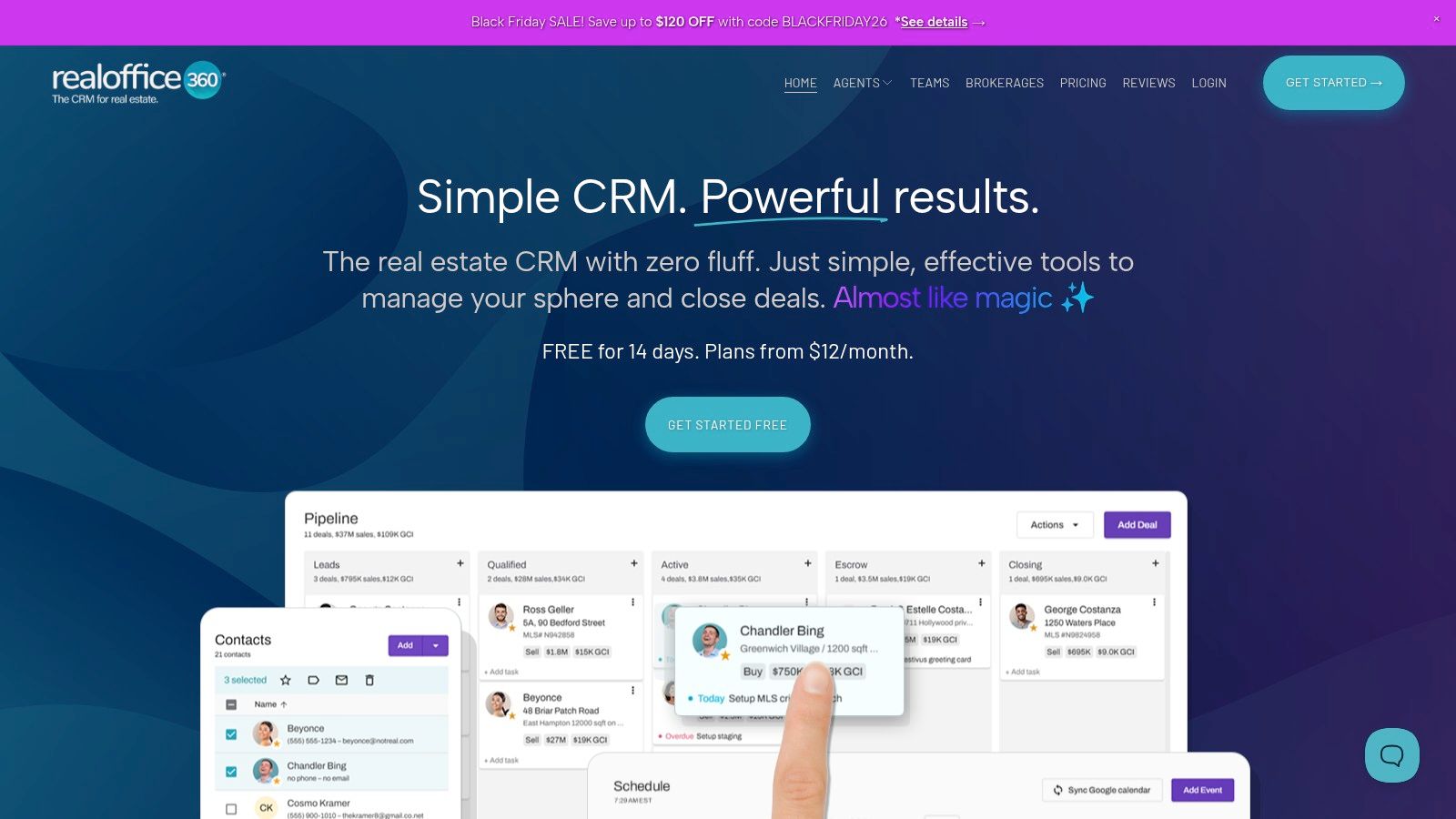
RealOffice360 belongs on a solo agent's shortlist when the priority is remembering people, tracking deals, and organizing commissions. It's a different proposition from a platform built around paid lead acquisition or a replacement website.
RealOffice360 presents contact records, reminders, follow-up tasks, deal pipelines, goals, commission tracking, and mobile and desktop access. Higher plans add workflows, integrations, bulk email, and team functions, while the vendor offers trial access without requiring a credit card.
The appeal is the alignment between the product's core functions and an agent's personal operating routine. An agent focused on referrals may care more about a reliable next-contact reminder than advanced routing rules.
An agent shouldn't buy a marketing suite to solve a task-management problem.
Watch the boundary between organization and automation
RealOffice360's entry-level positioning warrants investigation, but it doesn't establish better value without a current plan comparison. Pipeline limits and feature gates matter more than an inexpensive starting tier if the agent immediately needs an upgrade.
The evaluation should cover these practical distinctions:
- Relationship work: Can contacts be grouped by buyer, seller, past client, and referral relationship?
- Deal organization: Does the pipeline retain the property, next task, and expected commission information the agent needs?
- Plan fit: Are necessary workflows, bulk email, and integrations included in the proposed subscription?
Essentials has a restricted active pipeline, so agents should compare its allowance with their actual workload. Teams needing extensive lead distribution or marketing automation should also examine the higher tiers rather than assuming the entry plan represents the entire product.
RealOffice360 ranks here because a narrower scope can be appropriate, not because fewer features are easier to use. The trial still needs to establish whether the agent can maintain useful records between appointments without postponing every update until the end of the day.
4. Top Producer
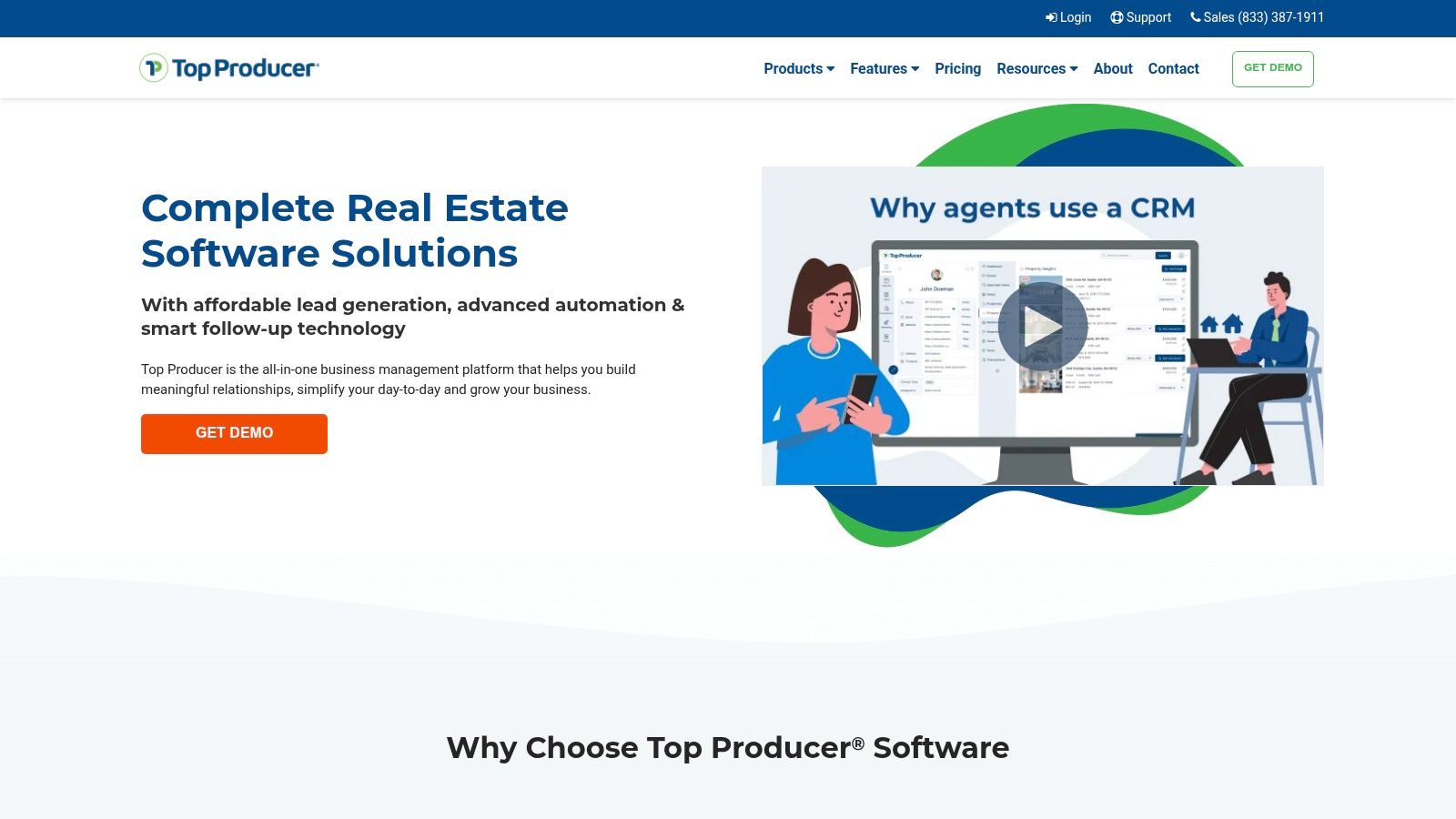
Top Producer is the specialist pick for agents who want market and property information connected to client follow-up. Its strongest reason for consideration isn't that it stores contacts or automates messages.
Top Producer describes MLS integration, branded Market Snapshot reports, automated text and email lead response, transaction management, and individual and team plans. Optional lead-generation and farming packages broaden the offering, but they also require a separate assessment of scope and cost.
An agent who routinely sends local market updates should evaluate the complete process. The relevant question is whether the CRM can support an appropriate report, preserve the communication history, and create the next follow-up without assembling those steps across disconnected tools.
Local coverage comes before package breadth
MLS integration is only useful when the required local service is supported under workable terms. Buyers should establish the relevant coverage, available information, update behavior, and any additional fees before treating the integration as a purchasing advantage.
- Best reason to shortlist: Market information can be incorporated into ongoing client communication.
- Main qualification: Lead and farming packages should be judged separately from the CRM subscription.
- Budget concern: A larger package may be unnecessary when the agent only needs reminders and basic nurturing.
Agents comparing a market-connected workflow with another real estate contact-management option can include the IXACT Contact review in their evaluation.
Top Producer's position reflects its more specific fit. It can deserve priority over a general follow-up hub for an agent whose daily work centers on property updates, but that doesn't make its broader packages necessary for every buyer.
The demonstration should use a realistic client scenario: a buyer changes search requirements, the agent sends relevant information, and the CRM records the next action. A relevant client conversation matters more than the presence of an MLS logo.
5. Real Geeks

Buying Real Geeks means evaluating more than a CRM. Its fit is an integrated website-to-follow-up workflow, particularly for agents who want property searches and inquiries connected to their lead records.
Real Geeks bundles an IDX-enabled website with CRM lead management, routing, filters, activity alerts, email and text workflows, saved searches, and property alerts. The vendor also lists onboarding, training, U.S.-based support, and optional advertising and AI texting capabilities.
That combination changes the comparison. A standalone CRM subscription and a website package solve different portions of the workflow, so their headline costs shouldn't be treated as equivalent purchases.
Compare the replacement cost, not just the subscription
A team replacing an existing website should identify which current expenses would disappear. Hosting, property-search functionality, maintenance, marketing services, and CRM subscriptions may overlap, but an overlap isn't a saving unless the old service can be retired.
Buying distinction: An integrated platform has a stronger value case when it replaces tools the team would otherwise continue paying for.
The purchasing review should separate the base platform from setup charges, commitment terms, additional users, extra MLS feeds, marketing services, and optional automation. Website portability and contact export also deserve attention before signing.
A realistic demonstration should follow a visitor from property search to registration, lead assignment, agent response, and subsequent activity alert. Buyers can use the Realvolve review as another comparison point when examining their CRM requirements.
Real Geeks ranks below the standalone options because replacing a website introduces an additional purchasing decision. For an agent who needs that replacement anyway, however, the bundled workflow may make it a more relevant finalist than a higher-ranked CRM-only product.
6. Lofty

Lofty suits buyers evaluating a broader real estate platform rather than a contact-management replacement. Its appeal depends on whether property activity, nurturing, websites, and marketing need to operate together.
Lofty describes a real estate CRM with Smart Plans, automated nurturing, property alerts, lead scoring, website options, marketing tools, and AI capabilities. Its Agent, Team, Broker, and Enterprise packages use quote-based pricing rather than a straightforward public rate card.
The most useful evaluation starts with behavior, not feature names. For example, a returning prospect saves a property after a long period without contact. Buyers should examine what information appears in the record, what automation follows, and when an agent takes over.
Require a package-specific demonstration
A broad demonstration can show capabilities that aren't included in the proposed purchase. Every necessary feature should be attached to the quoted package, including the website, lead-generation services, communications allowances, and AI functions.
- Feature potential: Property-search activity can inform nurturing and agent follow-up.
- Ease-of-use uncertainty: Buyers still need to establish whether agents can manage the daily queue without excessive configuration.
- Value uncertainty: Quote-based packaging prevents a defensible cost ranking without a comparable proposal.
Teams reviewing platform breadth can also consult the Propertybase review while defining their requirements.
Lofty sits below more focused options because a broader scope creates more purchasing questions, not because breadth is undesirable. An agent needing little beyond contact records and reminders may be paying for an operating model that doesn't match the business.
For a team intending to consolidate several functions, the calculation can differ. The stronger case is a documented replacement plan, showing which tools will be retired, who will configure the workflows, and how agents will manage exceptions when automated outreach needs human judgment.
7. BoldTrail
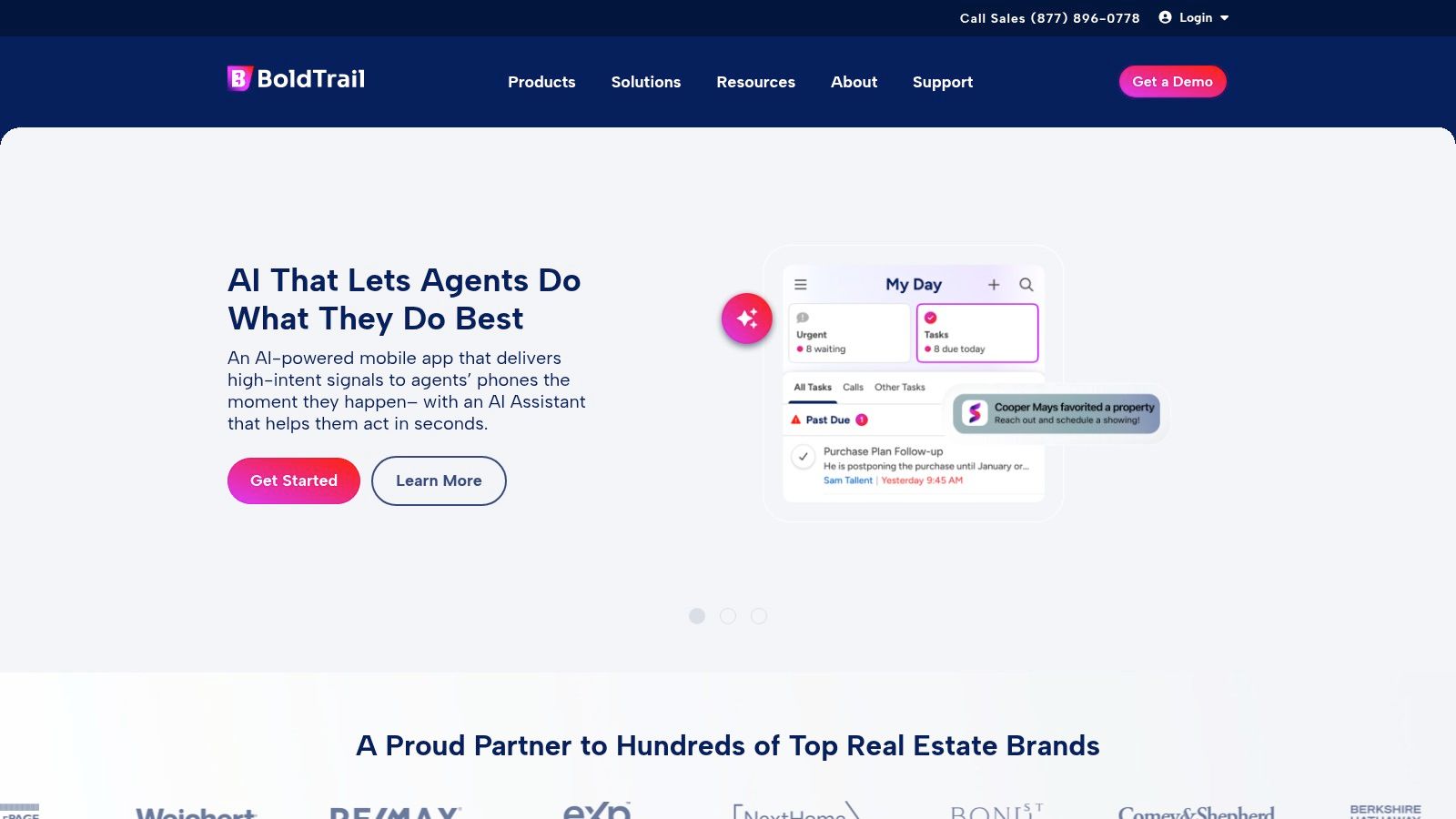
A brokerage buying shared infrastructure has different requirements from a solo agent buying a reminder system. BoldTrail is the brokerage-oriented shortlist option, particularly when website, marketing, and related operational modules are part of the same decision.
BoldTrail describes a Smart CRM with behavior-based lead prioritization, connected IDX websites, email and text campaigns, templates, automated follow-up, and optional transaction, recruiting, and brokerage-related modules. Pricing is custom and depends on the account, selected products, and add-ons.
That breadth requires a defined implementation owner. A brokerage should establish who manages lead assignment, campaign changes, permissions, onboarding, and reporting before assuming a shared platform will produce consistent working practices.
Separate agent work from brokerage administration
The agent-facing demonstration should show the next prospect to contact, the reason for prioritization, and the communication history. The administrator demonstration should show how responsibility, access, and workflow changes are controlled.
Those are related requirements, but they aren't interchangeable. A capable management console doesn't establish that agents will use the CRM consistently.
- Operational fit: A shared ecosystem can be relevant when the brokerage wants coordinated website, marketing, and lead-management processes.
- Implementation trade-off: Broader functionality can require more configuration and learning than a focused CRM.
- Commercial qualification: The quote should identify modules, integrations, onboarding responsibilities, and optional services.
BoldTrail's placement reflects the narrower audience for a large platform purchase. An independent agent seeking straightforward follow-up shouldn't assume brokerage-oriented breadth offers additional personal value.
The practical buying test is whether each included module has a named user and a defined job. If the proposed package contains capabilities without an owner or an implementation plan, those capabilities shouldn't improve its value assessment merely because they appear in the contract.
Real estate CRMs side by side
The table below summarizes the practical differences that matter before requesting quotes. Where a vendor does not publish a term clearly, treat that row as a question to settle during the demonstration rather than an assumption.
| CRM | Pricing model | Best for | Lead capture and routing | Website or IDX included | Trial |
|---|---|---|---|---|---|
| Follow Up Boss | Monthly plans; no contract | Teams consolidating leads from existing tools | Lead capture with routing and assignment rules | No; use existing website tools | Trial access offered; confirm length with the vendor |
| Wise Agent | Flat-rate plan; extra user access may cost more | Small teams seeking CRM and marketing tools | Lead automation, contact management, and drip campaigns | Landing pages included; confirm whether a full website bundle is available | Trial access offered; confirm length with the vendor |
| RealOffice360 | Tiered plans; confirm current plan costs before comparing value | Solo agents managing contacts, deals, and commissions | Contact management and follow-up tasks; advanced workflows on higher tiers | Confirm with the vendor | Trial access offered without a credit card; confirm length |
| Top Producer | Tiered plans; lead and farming options cost extra | Agents connecting market information with follow-up | Automated SMS and email lead response | Confirm with the vendor | Confirm trial availability with the vendor |
| Real Geeks | Bundled platform; setup fee and commitment terms apply, so compare it as a package rather than against standalone CRMs | Agents seeking an integrated website and CRM | IDX inquiries feed into CRM; routing, alerts, and follow-up workflows | Yes; IDX website included | Confirm trial availability with the vendor |
| Lofty | Quote-based packages | Agents, teams, or brokerages wanting an integrated platform | Lead scoring, property alerts, and automated nurturing | Website and IDX options available | Confirm trial availability with the vendor |
| BoldTrail | Custom pricing based on account and products | Teams and brokerages needing a broad platform | Behavior-based lead prioritization, capture, and automated follow-up | Yes; IDX websites included | Confirm trial availability with the vendor |
Read the pricing column as structure, not cost ranking. A flat-rate plan, a tiered plan, and a quoted package are not directly comparable numbers, and per-user charges change the math as a team grows. Two entries illustrate the range: Wise Agent prices around a flat rate, while Lofty and BoldTrail quote per account, so the same headcount can produce very different totals depending on which model applies.
The website column carries similar weight. Real Geeks and BoldTrail bundle IDX websites into the platform, Follow Up Boss expects you to bring your own, and Wise Agent covers landing pages without a confirmed full site. An agent who already pays for an IDX website should treat a bundled platform as a replacement cost question, since paying for both removes much of the bundle's appeal.
Two checks close most gaps this table leaves open. First, ask each vendor to state the trial length, setup charges, and commitment term in writing. Second, confirm whether lead routing, texting, and AI features sit inside the quoted plan or behind add-ons, because those answers determine which column differences affect your monthly bill.
How to Pick Your Real Estate CRM
The best CRM for real estate agents is the product that supports the actual lead-to-client workflow at an acceptable total cost. CRM remains relevant to that decision: in the 2025 REALTORS® Technology Survey, 23% of respondents identified CRM as the technology producing the highest number of quality leads, according to the National Association of REALTORS® survey report.
That finding doesn't identify a winning vendor or prove a conversion increase. It supports evaluating how reliably a system organizes opportunities and prompts appropriate follow-up.
Match the workflow, price the package, test the work
First, match the CRM to lead sources and team size. Follow Up Boss is the starting point for an existing technology stack needing coordinated follow-up. Wise Agent and RealOffice360 deserve attention for contact and organizational work, while Top Producer fits property-informed communication; Real Geeks, Lofty, and BoldTrail warrant consideration when website or platform consolidation is part of the purchase.
Next, confirm the complete cost. The comparison should include required users, separate logins, calling, texting, AI services, MLS access, advertising, onboarding, setup charges, and commitment terms. Any eventual price comparison should name the vendor, billing basis, included capabilities, and date checked.
Finally, run a trial or controlled demonstration using representative leads. Include an unresponsive inquiry, an active buyer, a seller prospect, and a past client. Agents should capture the contact, identify the owner, record a conversation, schedule follow-up, pause automation, and retrieve the history from a mobile device.
A successful demonstration shows how agents handle exceptions, not just how automation behaves when everything goes as planned.
KeenVerdict compares documented features and published prices, without claiming hands-on testing. This shortlist doesn't substitute unsupported scores or unchecked prices for missing evidence; its CRM statistics and Software Buying Statistics pages provide additional sourced context for the purchasing decision.
The final choice should follow the operating model, not the ranking alone. A lower-ranked product can be the better fit when it solves the business's specific problem without requiring an unnecessary website migration or platform rollout.
Choose the relevant finalists, obtain itemized proposals, and run the same lead scenario through each. Use KeenVerdict's CRM statistics and software buying pages alongside those proposals, then select the product whose daily workflow, access model, and complete cost the team can clearly explain.
Cite this page
KeenVerdict. Best CRM for Real Estate Agents: 2026 Comparison. Updated November 29, 2026. https://keenverdict.com/best-crm-for-real-estate-agents
Questions or corrections: editorial@keenverdict.com