10 Best Mental Health Apps of 2026
By the KeenVerdict research desk · Updated November 20, 2026 · Next review January 4, 2027 · 10 products scored
 Our pickWysaPeople who want free, anonymous CBT-style support from a chat app9.0
Our verdict
Start with Wysa if you want a free app that responds to how you feel and suggests a CBT-style exercise, without handing over personal data. MindShift CBT is the most complete free CBT toolkit for anxiety and its maker cites a 16-week clinical trial of 380 adults. How We Feel and Daylio are the most private trackers. Headspace is the best paid app if you want guided meditation and a route to coaching or therapy, while Clarity offers the deepest CBT journals for USD $60 a year. Calm is the pick for sleep but costs the most and lists tracking on its App Store label.
The short answer
Wysa is the best free mental health app for stress, anxiety and low mood in 2026: chatting with its AI and the CBT-style tools offered in conversation cost nothing, and its US App Store privacy label lists no data linked to you. MindShift CBT suits people who want structured CBT for anxiety at no cost, and How We Feel is a free, nonprofit mood journal that keeps data on your device unless you opt in. As of November 2026, Headspace costs $12.99 a month and Calm $79.99 a year; anyone with severe or persistent symptoms should use a licensed therapy service instead.
This list is for adults managing everyday stress, anxiety and low mood with self-help apps. We judged each app on three things the angle calls for: what it costs, what evidence the maker cites, and what its privacy terms and US App Store privacy label say. We compared documented features and published prices; we did not run clinical tests. Prices come from vendor pages or the US App Store and were checked in November 2026. Woebot is not included because its consumer app was shut down, and therapy services such as BetterHelp and Talkspace are covered in our online therapy list instead. None of these apps is a crisis service or a replacement for treatment.
At a glance
| Rank | Product | Best for | Price | Score |
|---|---|---|---|---|
| 1 | Wysa | People who want free, anonymous CBT-style support from a chat app | $6.25 per month, billed $74.99 yearly (US App Store); free plan | 9.0 |
| 2 | MindShift CBT | People with mild to moderate anxiety who want structured CBT for free | Free; no subscriptions or in-app purchases | 8.9 |
| 3 | How We Feel | People who want a free, private mood journal with short coping videos | Free, funded by donations | 8.8 |
| 4 | Headspace | Beginners who want guided meditation plus a path to coaching or therapy | $12.99 per month, or $69.99 per year (US App Store) | 8.7 |
| 5 | Clarity | People who want CBT thought journals with free core features | $5 per month, billed USD $60 yearly; free plan | 8.6 |
| 6 | Calm | People whose stress shows up mainly as poor sleep | $6.67 per month, billed $79.99 yearly | 8.3 |
| 7 | Finch | People who struggle to keep a self-care habit | Price not listed | 8.3 |
| 8 | Moodfit | People who want to link mood with sleep, exercise and medication | Price not listed | 8.3 |
| 9 | Daylio | People who want the fastest possible mood log | Price not listed | 8.2 |
| 10 | MindDoc | People who want symptom tracking with feedback to share with a doctor | $5.83 per month, billed $69.99 for 12 months (US App Store); free plan | 8.2 |
By the numbers
- 17.3%The share of US adults who practiced meditation more than doubled from 7.5% in 2002 to 17.3% in 2022, according to the National Health Interview Survey, the latest year with national data.Source: National Center for Complementary and Integrative Health (NIH)
- 58% to 75%Between 58% and 75% of US meditators have used a meditation app at least once, and 21% to 23% use one regularly, according to cross-sectional studies cited in a 2024 Scientific Reports paper.Source: Scientific Reports (Davies et al.)
- 4.7%Mindfulness and meditation apps retained a median 4.7% of users at day 30 in the same 2017 to 2018 data, better than breathing exercise apps at 0.0% but behind peer support apps at 8.9%.Source: Journal of Medical Internet Research (Baumel et al.)
- 0.85A randomized trial of 1,458 US academic medical center employees, published in JAMA Network Open in 2025, found an 8-week digital meditation program reduced perceived stress with a Cohen d of 0.85 against a waiting list.Source: JAMA Network Open (Radin et al.)
- 0.71The stress reduction in the same 2025 trial held at 4 months after randomization, with a Cohen d of 0.71.Source: JAMA Network Open (Radin et al.)
- 0.53A 2026 meta-analysis of 17 randomized trials with 1,641 non-clinical adults found mindfulness programs lowered perceived stress by a standardized mean difference of 0.53.Source: npj Mental Health Research (Rajan et al.)
How we scored
Every product gets the same three scores out of 10. We compared documented features and published prices; we did not run hands-on tests.
- 40%Features
- 30%Ease of use
- 30%Value
No. 1, our pick
WysaAn AI chat companion for low mood, stress and anxiety, with a library of CBT, solution-focused and mindfulness exercises.
9.0of 10Best for People who want free, anonymous CBT-style support from a chat app
- Features
- 9.0
- Ease of use
- 8.8
- Value
- 9.2
Price
Free AI chat and in-chat tools; Wysa Premium on the US App Store from $74.99 per year, with other Premium and coaching options listed
Quoted from the Wysa pricing page on November 20, 2026:
Wysa Premium (Annual) $74.99
Wysa is a chat-first app: you type how you feel and an AI, built from rule-based scripts and large language models, replies and suggests a skill to try. Its FAQ says the techniques draw on Cognitive Behaviour Therapy, Solution Focussed Therapy and mindfulness, and that all content is clinically approved before release. The free version covers the chat and any tools offered inside it, which is more than most rivals give away. Premium adds a browsable library, and some regions can add paid human coaching. Privacy is the strongest point: Wysa says it does not request personal data and that conversations are not shared, and the US App Store label lists no data linked to your identity and no tracking. The weak spots are a confusing set of App Store prices, from $4.99 to $99.99 for Premium options, and a clear statement from Wysa that it is not built for crises or severe, long-term conditions.
What works
- +Wysa says it does not request your personal data and keeps conversations private
- +US App Store privacy label lists no data linked to you and no tracking
- +Free tier includes the chat and the tools offered inside it
What does not
- −The full tool library sits behind Premium
- −The App Store lists several Premium prices ($4.99 to $99.99), which makes the real cost hard to read
- −Wysa states it is not suitable for severe and enduring mental health problems
- Free plan
- Yes, AI chat and in-chat tools
- Premium
- From $74.99 per year (US App Store)
- Approaches
- CBT, Solution Focused Therapy, mindfulness
- Minimum age
- 13 (11 via some institutions)
- App Store privacy label
- Data not linked to you; no tracking listed
No. 2
 MindShift CBT
A free CBT app for anxiety, worry, panic, social anxiety and perfectionism, built around thought records and fear ladders.
8.9of 10Best for People with mild to moderate anxiety who want structured CBT for free
- Features
- 8.4
- Ease of use
- 8.6
- Value
- 9.8
Price
Free; no subscriptions or in-app purchases
Quoted from the MindShift CBT pricing page on November 20, 2026:
Always Free: No subscriptions, no hidden costs.
MindShift CBT is the most direct way to practise classic CBT for anxiety without paying anything. Every tool maps to a named technique: Thought Records for cognitive restructuring, Facing Fears ladders for graded exposure, and relaxation and mindfulness audio. The FAQ says a 16-week clinical trial of 380 adults showed significant improvement in anxiety, function and quality of life, and the site notes an assessment under the Mental Health Commission of Canada framework. You can start without an account, and creating one adds backup and sync. The maker says it does not sell personal data and lets account holders delete data from settings. A useful extra is an export of thought records and fear ladders to share with a therapist. Limits are clear: it covers anxiety rather than depression or sleep, it ships in English and French only, and there is no chat or coaching layer.
What works
- +Completely free with no in-app purchases on the US App Store
- +Maker cites a 16-week clinical trial of 380 adults
- +Core tools work without creating an account
What does not
- −Available in English and French only
- −Focused on anxiety, with little for low mood or sleep
- −No chat or coaching
- Price
- Free, no subscriptions
- Evidence cited
- 16-week clinical trial of 380 adults
- Languages
- English and French
- Account
- Optional, for backup and sync
- Data
- Maker says it does not sell personal data
No. 3
 How We Feel
A free mood journal from a nonprofit that helps you name emotions precisely and try short regulation strategies.
8.8of 10Best for People who want a free, private mood journal with short coping videos
- Features
- 7.8
- Ease of use
- 9.0
- Value
- 9.8
Price
Free, funded by donations
Quoted from the How We Feel pricing page on November 20, 2026:
It's free—made possible by donations.
How We Feel is a mood journal from The How We Feel Project, a nonprofit created in 2020, and it is free because donations fund it. The core habit is a quick check-in where you pick a precise word for your feeling on a color-coded grid, an idea developed with Yale University's Center for Emotional Intelligence and the work of Dr Marc Brackett. Over time the app links your check-ins with sleep, exercise and health trends from Apple HealthKit. When you need to act, short video strategies are grouped under Change Your Thinking, Move Your Body, Be Mindful and Reach Out, so there is some cognitive work, though not a full CBT program. Its privacy terms are among the plainest here: data stays on your device unless you opt in to send an anonymized version of check-ins for research. It is lighter than MindShift or Clarity on structured exercises.
What works
- +Free with no in-app purchases on the US App Store
- +Data stays on your device unless you opt in to share an anonymized copy
- +Built with input from Yale's Center for Emotional Intelligence
What does not
- −No structured CBT course or thought-record workflow
- −The App Store version is for iPhone only
- −Less useful for acute anxiety or panic than a dedicated tool
- Price
- Free, donation funded
- Publisher
- The How We Feel Project, a nonprofit founded in 2020
- Data storage
- On device unless you opt in
- Strategy themes
- Change Your Thinking, Move Your Body, Be Mindful, Reach Out
No. 4
 Headspace
A mindfulness and mental health app with meditations, courses, an AI companion called Ebb, and optional coaching and therapy.
8.7of 10Best for Beginners who want guided meditation plus a path to coaching or therapy
- Features
- 9.2
- Ease of use
- 9.2
- Value
- 7.6
Price
$12.99 per month or $69.99 per year on the US App Store; therapy and coaching billed separately
Quoted from the Headspace pricing page on November 20, 2026:
Monthly Subscription $12.99
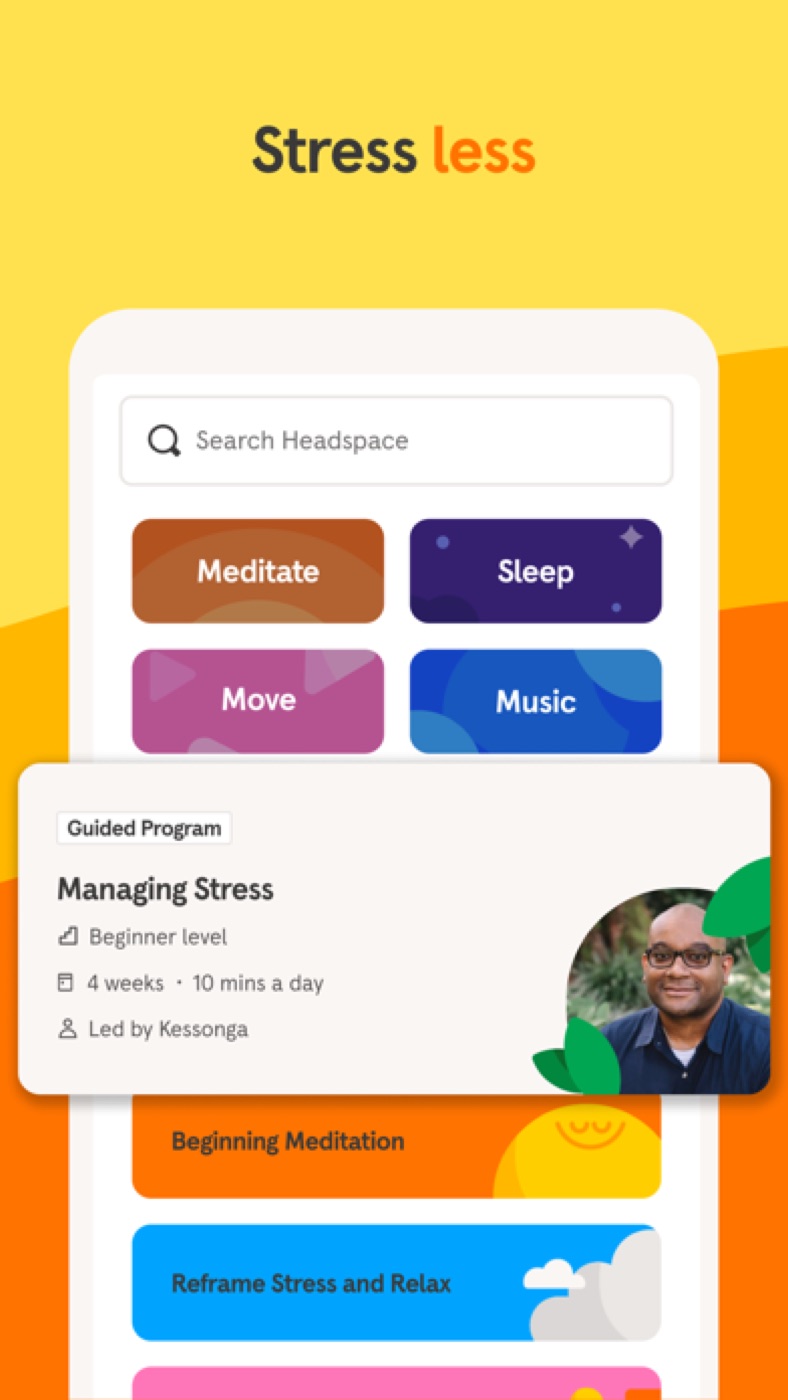
Headspace is the most polished option for people who want guided practice first and more support later. The app lists 500+ guided meditations, breathwork for anxiety and panic, and courses and programs that it describes as science-backed; its store listing claims that 2 weeks of Headspace reduces anxiety. Ebb, an AI companion, offers support between sessions, and licensed therapists and mental health coaches are available as separate services, with insurance partnerships for therapy. Pricing on the US App Store is $12.99 a month or $69.99 a year, and there is no permanent free plan. On privacy, the App Store label lists data linked to you, including purchases, coarse location, identifiers and advertising data, though no tracking across other companies' apps. Headspace is easy to recommend for stress and sleep, but it is a weaker fit than MindShift or Clarity if you want CBT worksheets.
What works
- +Largest guided content library on this list
- +Annual plan works out to about $5.83 a month
- +Clear path from self-help to coaching or therapy in one app
What does not
- −No permanent free plan
- −US App Store privacy label lists data linked to you, including advertising data
- −Therapy and coaching cost extra
- Monthly price
- $12.99 (US App Store)
- Annual price
- $69.99 (US App Store)
- Meditations
- 500+
- Evidence claim
- Store listing says 2 weeks of Headspace reduces anxiety
No. 5
 Clarity
A CBT journal for stress, anxiety and low mood with thought reframing, check-ins and an AI chatbot.
8.6of 10Best for People who want CBT thought journals with free core features
- Features
- 8.8
- Ease of use
- 8.4
- Value
- 8.6
Price
Free core CBT features; Clarity Pro USD $60 per year
Quoted from the Clarity pricing page on November 20, 2026:
Clarity Pro unlocks all 60+ guided journals, AI features, clinical assessments, crash courses, and more for USD $60/year.
Clarity is a CBT journal first: its free Analyze Thought tool walks you through spotting and challenging cognitive distortions, and daily check-ins, mood tracking and insights are also free with no account required. Clarity Pro costs USD $60 a year and adds 60+ guided journals, AI journaling and chat, clinical assessments and crash courses. The site says the app draws on CBT, DBT, ACT, positive psychology and mindfulness, and lists a psychiatrist as chief medical officer. Privacy needs a closer read. The website says your data stays on your device, but the US App Store label lists identifiers and usage data that may be used to track you across other companies' apps. For people who want worksheets and reframing rather than meditation, Clarity has the deepest CBT toolkit here at a low annual price.
What works
- +Core CBT tools free forever with no account required, per the maker
- +Pro is $60 a year, cheaper than Headspace or Calm
- +Leadership includes a board-certified psychiatrist
What does not
- −US App Store privacy label lists identifiers and usage data used to track you
- −Most guided journals need Pro
- −AI chat may not suit people who want a human
- Free plan
- Yes, core CBT journal, check-ins and insights
- Pro price
- USD $60 per year
- Approaches
- CBT, DBT, ACT, positive psychology, mindfulness
- Languages
- 10
No. 6
 Calm
A meditation and sleep app with daily meditations, Sleep Stories, soundscapes, music and breathing exercises.
8.3of 10Best for People whose stress shows up mainly as poor sleep
- Features
- 8.6
- Ease of use
- 9.0
- Value
- 7.2
Price
$79.99 per year after a 14-day web trial
Quoted from the Calm pricing page on November 20, 2026:
If you do not cancel, the trial automatically converts into a paid Annual Subscription ($79.99/year) on Day 15.
Calm is built around sleep and relaxation: daily meditations, Sleep Stories, soundscapes, music and breathing exercises. For people whose anxiety shows up at night, that library is the main reason to choose it. Calm's support page spells out the web trial: a 14-day free trial that converts into a $79.99 annual subscription on day 15 unless you cancel at least 24 hours before it ends. That makes it the priciest annual plan on this list. On privacy, the US App Store label is the least favorable here, listing purchases, identifiers and usage data that may be used to track you across other companies' apps, plus data linked to you for third-party advertising. Calm offers little in the way of thought records or CBT worksheets, so it ranks below apps built for anxiety and mood work.
What works
- +Deep sleep library for bedtime stress
- +Clear trial terms on its support page
- +Simple daily routine
What does not
- −Most expensive annual plan here at $79.99
- −US App Store label lists purchases, identifiers and usage data used to track you
- −Few CBT-style exercises
- Annual price
- $79.99 (web)
- Free trial
- 14 days on the web
- App Store privacy label
- Tracking listed: purchases, identifiers, usage data
No. 7
 Finch
A self-care pet app that turns mood checks, journaling and breathing into small daily goals.
8.3of 10Best for People who struggle to keep a self-care habit
- Features
- 7.8
- Ease of use
- 9.0
- Value
- 8.4
Finch makes self-care feel like caring for a small pet: you complete quick mood checks, journaling prompts, breathing sessions or goals, and your pet grows and goes on adventures. Under the game layer are useful tools, including a mood tracker with trends, quizzes that track anxiety and depression over time, and insights that combine your mood, journal tags, goals and quiz results. It is free to download, and Finch Plus is an optional subscription; the US App Store lists many Finch Plus prices, so we left the price pending. The privacy label lists data linked to you for functionality and analytics but no tracking. Finch is rated 4.9 from 778K ratings on the US App Store and is an Editors' Choice. It suits people who drop habits easily, but it does not cite a clinical trial and lacks structured CBT exercises.
What works
- +Apple Editors' Choice with a 4.9 rating from 778K ratings on the US App Store
- +No tracking listed on its App Store privacy label
- +Run by Finch Care, a public benefit corporation
What does not
- −Many Finch Plus prices on the App Store, so the real cost is unclear
- −Game-style rewards can turn into box-ticking
- −No structured CBT program or published trial cited
- Price
- Free download; Finch Plus subscription optional
- App Store rating
- 4.9 from 778K ratings (US)
- Company
- Finch Care Public Benefit Corporation
No. 8
 Moodfit
A mental fitness app with a mood journal, CBT tools, breathwork, gratitude journal and PHQ-9 and GAD-7 tracking.
8.3of 10Best for People who want to link mood with sleep, exercise and medication
- Features
- 8.4
- Ease of use
- 8.0
- Value
- 8.4
Moodfit treats mental health like fitness: daily goals, a mood journal and trackers that show how sleep, exercise, nutrition, social time and medication relate to mood. Its CBT tools help you identify and dispute cognitive distortions, and breathwork, mindfulness and a gratitude journal round out the toolkit. The PHQ-9 and GAD-7 assessments are a useful way to watch depression and anxiety scores over time and share them with a clinician. You can get started for free, and the site offers a 7-day Premium trial; the US App Store lists several Premium prices without periods, so we left pricing pending. The privacy label lists data linked to you, including contact info, health data and coarse location, but no tracking. Moodfit suits people who like data, though the number of trackers can feel busy.
What works
- +Free to start, with a 7-day Premium trial
- +Validated PHQ-9 and GAD-7 tracking
- +No tracking listed on its US App Store privacy label
What does not
- −Premium price not clear from the App Store list
- −Many trackers can feel busy at first
- −No clinical trial cited by the maker
- Free plan
- Yes, Premium trial 7 days
- Assessments
- PHQ-9 and GAD-7
- Developer
- Roble Ridge Software LLC
No. 9
 Daylio
A micro-diary and mood tracker where you log mood and activities in two taps and review stats.
8.2of 10Best for People who want the fastest possible mood log
- Features
- 7.4
- Ease of use
- 9.0
- Value
- 8.6
Daylio is a micro-diary: you pick a mood and tap the activities you did, with optional notes, and the app turns those entries into weekly, monthly and yearly charts, a Year in Pixels view and correlations between activities and mood. It is the quickest way on this list to build a daily mood record, and an Apple Watch app makes it even faster. Privacy is a strength. Daylio says it does not send entries to its servers and cannot read them, backups go to your own Google Drive, and the US App Store label lists no data linked to you. It is free to download with Premium options; the App Store lists several Premium prices, so we left pricing pending. Daylio offers no CBT exercises or coping strategies, so treat it as a tracker to pair with MindShift CBT or Clarity.
What works
- +Maker says entries are not sent to its servers
- +US App Store label lists no data linked to you
- +Fastest logging of any app here
What does not
- −No CBT exercises or coping tools
- −Premium price not clear from the App Store list
- −Insights depend on you choosing good activity tags
- Free plan
- Yes
- Data storage
- On device, optional Google Drive backup
- Platforms
- iPhone, iPad, Apple Watch
No. 10
 MindDoc
A mood tracking and CBT course app from clinical psychologists, registered as a class I medical product in the EU.
8.2of 10Best for People who want symptom tracking with feedback to share with a doctor
- Features
- 8.4
- Ease of use
- 8.0
- Value
- 8.0
Price
Free to download; MindDoc Plus on the US App Store, 12 months $69.99, with 3- and 6-month plans listed
Quoted from the MindDoc pricing page on November 20, 2026:
12 Months $69.99
MindDoc, from MindDoc Health GmbH, asks short questions about your mood through the day and turns the answers into regular feedback on symptoms, problems and resources, plus an overall emotional health assessment you can download and share with a health care provider. The app was developed by clinical psychologists and is registered as a class I medical product under the EU Medical Device Regulation, and the maker says it was evaluated in a clinical study with more than 1,000 participants. A CBT-based course library covers depression, anxiety, insomnia, eating disorders, stress and relationships, with most courses in MindDoc Plus; the US App Store lists 12 months at $69.99 alongside 3- and 6-month plans. MindDoc cites ISO 27001 and GDPR compliance, yet its US App Store label lists identifiers and usage data that may be used to track you. It is the most clinical tracker here.
What works
- +Maker cites a clinical study with more than 1,000 participants
- +ISO 27001 certified and GDPR compliant, per the maker
- +Assessment you can share with a health care provider
What does not
- −US App Store label lists identifiers and usage data used to track you
- −Most courses need MindDoc Plus
- −iPhone only on the App Store
- MindDoc Plus
- $69.99 for 12 months (US App Store)
- Evidence cited
- Clinical study with more than 1,000 participants
- Regulatory status
- Class I medical product, EU MDR
- Security
- ISO 27001, GDPR
Before you choose
Decide between chat, exercises and tracking
Chat apps such as Wysa respond to what you type. Exercise apps such as MindShift CBT and Clarity walk you through thought records and exposure steps. Trackers such as Daylio, How We Feel and Moodfit show patterns over weeks. Many people combine one tracker with one exercise app.
Read the App Store privacy label before you sign up
On the US App Store, Wysa and Daylio list no data linked to you, while Calm, Clarity and MindDoc list identifiers or usage data that may be used to track you across other companies' apps. Labels are written by the developer and not verified by Apple, so read the privacy policy too.
Check what evidence the maker actually cites
MindShift CBT cites a 16-week trial of 380 adults, and MindDoc cites a clinical study with more than 1,000 participants. A claim such as 'science-backed' without a named study tells you less. Evidence for an app's method (CBT) is not the same as evidence for the app itself.
Compare annual prices and watch trials
Paid plans here run from USD $60 a year for Clarity Pro to $79.99 a year for Calm. Headspace is $12.99 a month or $69.99 a year. Trials convert automatically, so set a reminder before the last day.
Know when an app is not enough
Wysa, MindShift CBT and MindDoc all state that they do not replace professional care. If symptoms are severe, last for weeks or include thoughts of self-harm, contact a licensed clinician or a crisis line such as 988 in the US.
Questions readers ask
- What is the best free mental health app?
- Wysa is the best free mental health app for most people, because its AI chat and the CBT-style tools offered in conversation are free. MindShift CBT is the best fully free option for anxiety, with no subscriptions at all, and How We Feel is a free nonprofit mood journal.
- Are mental health apps private and safe with my data?
- Some are much more private than others. On the US App Store, Wysa and Daylio list no data linked to you, and How We Feel keeps data on your device unless you opt in, while Calm, Clarity and MindDoc list data that may be used to track you across other companies' apps. Read the label and privacy policy before you sign up.
- Which apps offer CBT-style exercises?
- MindShift CBT, Clarity, Wysa, Moodfit and MindDoc all offer CBT-style exercises. MindShift CBT covers thought records and fear ladders for free, Clarity's Analyze Thought journal is free with Pro at USD $60 a year, and MindDoc has a CBT course library in MindDoc Plus.
- Is there evidence that mental health apps work?
- Some makers cite specific studies. MindShift CBT cites a 16-week clinical trial of 380 adults, and MindDoc cites a clinical study with more than 1,000 participants. Others describe their content as evidence-based without naming a study, which is weaker support.
- How much do mental health apps cost?
- Several are free: MindShift CBT and How We Feel have no paid tier, and Wysa's chat is free. Paid plans checked in November 2026 include Clarity Pro at USD $60 a year, MindDoc Plus at $69.99 for 12 months, Headspace at $12.99 a month and Calm at $79.99 a year.
- Can a mental health app replace therapy?
- No. Wysa, MindShift CBT and MindDoc each state that their apps are not a substitute for professional care, and Wysa says it is not for crisis situations. Use an app alongside a licensed clinician if symptoms are severe or persistent.
Sources and price checks
- Wysa: apps.apple.com/us/app/wysa-mental-wellbeing-ai/id1166585565, checked November 20, 2026
- MindShift CBT: apps.apple.com/us/app/mindshift-cbt-anxiety-relief/id634684825, checked November 20, 2026
- How We Feel: howwefeel.org, checked November 20, 2026
- Headspace: apps.apple.com/us/app/headspace-sleep-meditation/id493145008, checked November 20, 2026
- Clarity: thinkwithclarity.com, checked November 20, 2026
- Calm: support.calm.com/hc/en-us/articles/360003084493-Calm-Web-Free-Trial-Sign-Up-Cancellation-Steps, checked November 20, 2026
- Finch: apps.apple.com/us/app/finch-self-care-pet/id1528595748, checked November 20, 2026, price not verified
- Moodfit: apps.apple.com/us/app/moodfit-mental-health-tools/id1054458809, checked November 20, 2026, price not verified
- Daylio: apps.apple.com/us/app/daylio-journal-mood-tracker/id1194023242, checked November 20, 2026, price not verified
- MindDoc: apps.apple.com/us/app/minddoc-mental-health-support/id1052216403, checked November 20, 2026
Cite this page
KeenVerdict. 10 Best Mental Health Apps of 2026. Updated November 20, 2026. https://keenverdict.com/best/best-mental-health-apps
Questions or corrections: editorial@keenverdict.com
Read our disclosure and editorial policy. Prices change often; check the vendor page before you buy.