Guide · General
Accounting for Invoices: Entries, Revenue and Receivables
Learn accounting for invoices step by step: journal entries, revenue timing, VAT fields, receivables aging and handling late or disputed payments.
By the KeenVerdict research desk · Updated November 17, 2026 · 14 min read
A customer has paid part of a bill, a supplier invoice is waiting for approval, and the bank balance doesn't match the profit shown in the accounts. Accounting for invoices means recording what's owed, separating revenue or expenses from tax, and matching each payment or adjustment to the right document.
Table of Contents
- Invoice Accounting in Brief
- Journal Entries for Each Invoice Stage
- Recognizing Revenue Separately From Invoice Dates
- Tax Fields and Records an Invoice Must Keep
- Tracking Receivables and Payment Due Dates
- Handling Disputed, Partial and Unmatched Payments
- Recording Purchase Invoices and Supplier Payments
- Set Up Your Monthly Invoice Routine
Invoice Accounting in Brief
An invoice records a commercial claim for payment. Once posted, it also supports the ledger, but sending an invoice, earning revenue and receiving cash aren't necessarily the same event.
A restaurant bill offers a useful comparison. The bill opens a tab, the ledger records the outstanding balance, and payment closes it. A correction can reduce the tab; an uncollectible balance needs a separate accounting decision rather than disappearing.
Under accrual accounting, an ordinary credit sale moves through these stages:
- Posting: The business records the customer's debt, earned revenue and applicable tax.
- Settlement: The bookkeeper matches cash received against that debt.
- Adjustment: An authorized credit note, impairment allowance or write-off changes the recorded position.
Practical rule: An invoice shows an amount billed. It doesn't, by itself, prove that revenue has been earned or cash collected.
Invoice records also support tax reporting. The OECD's 2022 report on electronic invoicing reports that Spain issued 203 million electronic business-to-business invoices in 2020, an 18% increase from 2019. Structured invoice information can pass directly into business and government systems, making accurate source records important beyond bookkeeping.
For a small business, the working record should connect the invoice identifier, issue and supply dates, trading parties, net amount, tax, gross total and payment status. Payment status usually belongs in the accounting system rather than among the legal fields printed on the original invoice. Keeping these records connected allows the bookkeeper to explain both the ledger balance and the next collection or payment action.
Journal Entries for Each Invoice Stage
| Invoice stage | Debit | Credit | Evidence and next action |
|---|---|---|---|
| Earned sale invoiced | Accounts receivable, gross amount | Sales revenue, net amount; VAT payable, applicable tax | Invoice and delivery evidence; confirm customer receipt |
| Full payment received | Bank | Accounts receivable | Bank receipt and remittance; close the invoice |
| Partial payment received | Bank, amount received | Accounts receivable, same amount | Remittance allocation; retain the unpaid balance |
| Advance received before delivery | Bank | Contract liability, excluding separately recognized tax | Contract and payment record; track the delivery obligation |
| Credit note approved | Sales returns or revenue adjustment; eligible VAT adjustment | Accounts receivable | Credit note linked to the original invoice; send the correction |
| Receivable written off | Loss allowance, or bad debt expense where appropriate | Accounts receivable | Approved recovery assessment; update collection records |
Posting an ordinary credit sale
Consider a hypothetical sale of $1,000 net, with $200 tax at an illustrative 20% rate, making $1,200 payable. The example assumes delivery is complete, revenue is earned and the applicable tax becomes payable at that point; actual rates and tax points differ by jurisdiction.
The bookkeeper debits accounts receivable $1,200, credits sales revenue $1,000 and credits VAT payable $200. Receivables increase because the customer owes money, revenue increases because the business has earned the sale, and the tax credit records an obligation to the tax authority.
When the customer pays the hypothetical $1,200 in full, the entry debits bank $1,200 and credits accounts receivable $1,200. Payment isn't another sale. Crediting revenue again would count the same income twice.
If the customer instead pays a hypothetical $600, the bookkeeper debits bank $600 and credits receivables $600, leaving $600 outstanding. The payment allocation must identify the invoice being settled, particularly when the customer has several open bills.
Adjustments need their own evidence
An advance follows a different route because the business may still owe goods or services. Cash increases, but a contract liability records the unfulfilled promise; any tax due on the advance needs separate treatment under local rules.
For a hypothetical credit note reducing the example sale by $100 net and $20 tax, the entry debits sales returns or revenue adjustment $100, debits VAT payable $20 where permitted, and credits receivables $120. The credit note should explain the commercial reason, such as returned goods or an agreed price reduction.
A write-off isn't a discount. It removes a balance when there's no reasonable expectation of recovery, using an existing allowance where one has already been recognized. Any bad-debt tax relief requires its own eligibility check rather than an automatic reversal of the original tax.
Every posting should carry the invoice identifier or a clear reference to the related adjustment. The document trail should let another bookkeeper move from the ledger entry to the invoice, approval, delivery record and bank transaction without guessing.
Recognizing Revenue Separately From Invoice Dates
The invoice date isn't automatically the revenue date. A business can bill before delivery, deliver before billing, or receive cash while substantial work remains.
The IFRS Foundation's 2023 review document for IFRS 15 describes recognition based on transferring promised goods or services, not merely issuing an invoice. The parallel US GAAP revenue framework, ASC 606, follows the same broad contract-based approach.
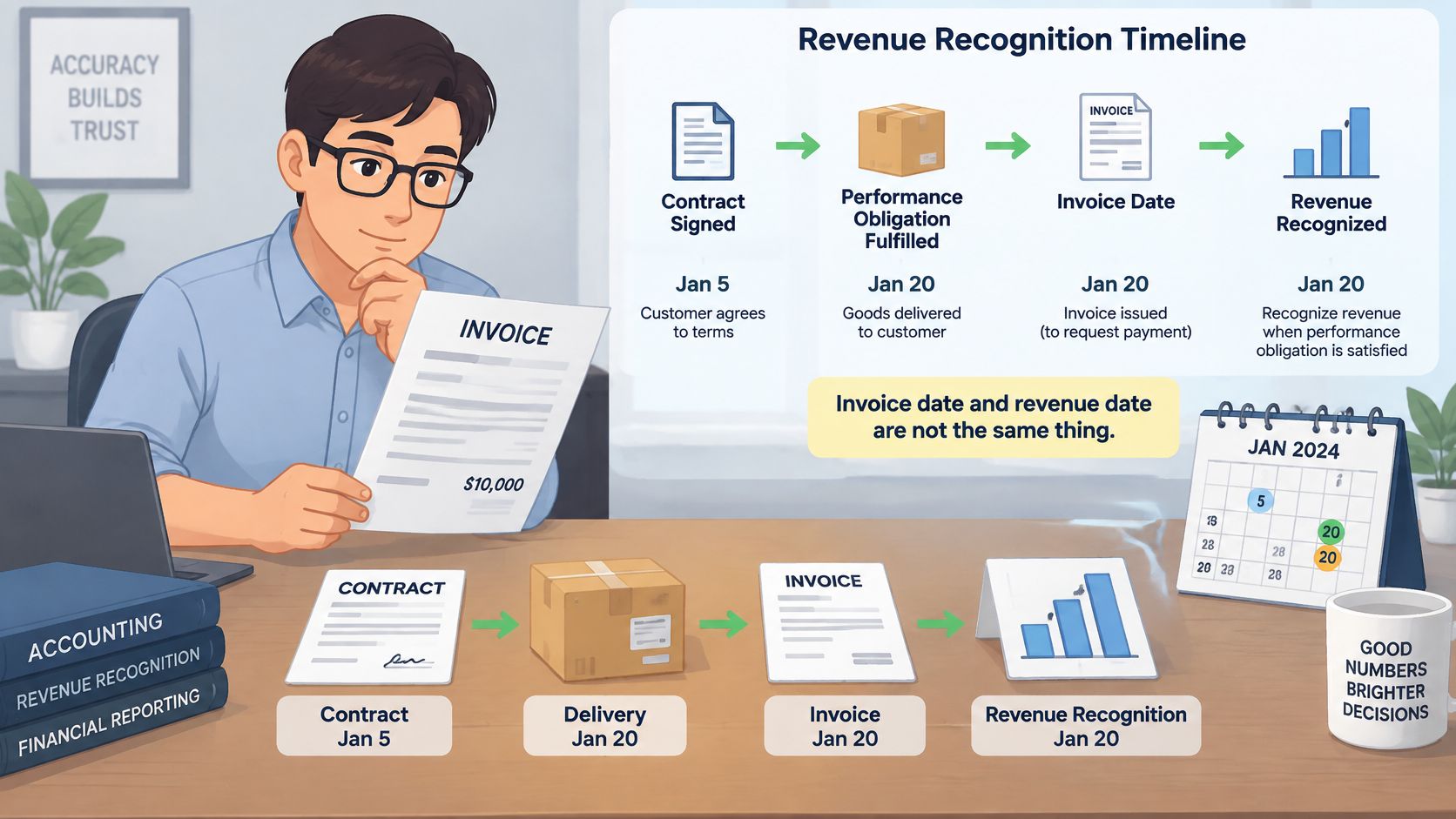
The recognition sequence
- Identify the contract: Establish the enforceable arrangement with the customer.
- Identify performance obligations: Separate distinct promises, such as equipment and an independently usable support service.
- Determine the transaction price: Establish the consideration expected, including relevant discounts or variable amounts.
- Allocate that price: Normally use relative standalone selling prices for the separate obligations.
- Recognize delivery: Record revenue when or as control transfers to the customer.
An annual support contract
Consider a hypothetical $12,000 annual support contract paid upfront, with service delivered evenly over twelve months. Ignoring tax for this timing example, receipt produces a $12,000 debit to bank and a $12,000 credit to contract liability, followed by monthly entries debiting that liability and crediting support revenue by $1,000.
The liability represents support still owed, not money owed back in every circumstance. As the business provides the service, the remaining obligation falls and earned revenue increases. Straight-line recognition is appropriate only when it faithfully represents how the service is delivered.
Billing before payment introduces another distinction. If an advance invoice creates an unconditional right to consideration, the business may record a receivable and contract liability before cash arrives; collection then clears the receivable. The contract terms determine whether that billing right exists.
The reverse situation occurs when qualifying performance has happened but payment still depends on something beyond the passage of time. The business may recognize a contract asset, then reclassify it to a receivable when the right becomes unconditional.
Invoice dates help establish billing and tax records. Revenue timing follows the underlying performance, not the convenience of the billing run.
At each reporting date, the finance owner should reconcile invoice dates, service periods, delivery evidence, contract changes and the contract-liability rollforward. That rollforward connects the opening deferred balance, new advance billings or receipts, revenue released and closing balance.
An unpaid balance can therefore be a receivable without being current-period revenue, while earned revenue can exist before an invoice. Treating those balances separately prevents the billing schedule from dictating reported performance.
Tax Fields and Records an Invoice Must Keep
A correct gross total doesn't guarantee a correct tax record. A missing supply date can put VAT in the wrong period, while an incorrect tax code can produce the right customer balance but the wrong tax return.
The UK's VAT record-keeping guidance provides a jurisdiction-specific example: a full VAT invoice needs identifying information, relevant dates, supply details and tax amounts, and businesses must retain sales invoices, including cancelled or mistaken invoices, and purchase invoices.
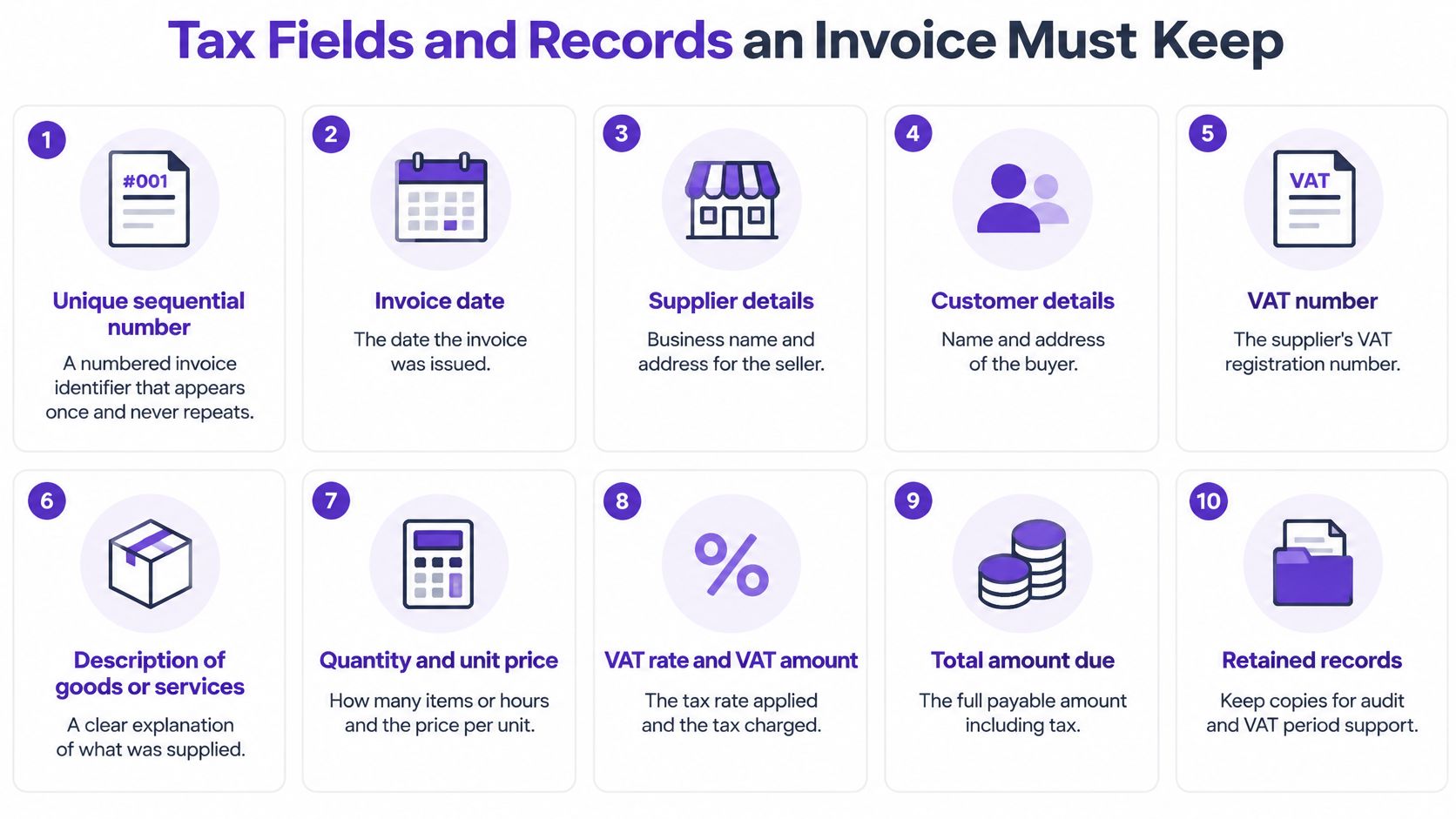
The fields that support the entry
For a full UK VAT invoice, the working checklist should include:
- Identification: A unique sequential invoice number, supplier name and address, supplier VAT registration number, and customer details.
- Dates: The issue date and the supply date where relevant, rather than assuming they're interchangeable.
- Supply description: A sufficiently specific explanation of the goods or services, including quantities or service extent.
- Amounts: Unit pricing where applicable, VAT-exclusive amounts, the VAT rate, VAT amount and gross total.
A description such as services may leave an approver unable to connect the charge to a contract. A description identifying the service period and deliverable gives the bookkeeper stronger support for classification, approval and cutoff.
Controls a bookkeeper can verify
- Lock invoice numbering. The system should preserve a traceable sequence and never reuse cancelled identifiers.
- Validate tax codes before posting. The assigned code should reflect the supply and relevant jurisdiction.
- Preserve originals unchanged. Corrections should remain visible through linked documents or an audit trail.
- Match purchase evidence. The invoice should agree with the approved order and receipt or service confirmation.
- Reconcile tax components. Net values, output tax, recoverable input tax and gross balances should tie to the relevant return workings.
Cancelled invoices shouldn't be deleted merely to make the sequence look tidy. Their retained status explains why an identifier exists without an active customer balance.
For US businesses, IRS record-keeping guidance lists invoices alongside sales slips, paid bills, receipts, deposit slips and canceled checks, and generally suggests keeping records for three years, while explaining that the required period depends on the underlying tax action, expense or event. An invoice-retention policy therefore shouldn't apply that period automatically to every transaction.
An invoice supports a transaction; it doesn't independently establish that every deduction or tax recovery is valid. The retention schedule should identify the tax return, supporting documents and circumstances that determine how long the complete evidence package remains necessary.
Tracking Receivables and Payment Due Dates
An aging report sorts every open sales invoice by how long it has gone unpaid, so each band can carry its own action.
| Days past due | Status | Accounting and collection action |
|---|---|---|
| Not yet due | Current | Keep in receivables and send a reminder according to the payment terms |
| 1 to 30 days | Early overdue | Confirm receipt with the customer and log each follow-up |
| 31 to 60 days | Escalation needed | Contact the payment approver and review further credit |
| 61 to 90 days | Recoverability review | Assess collection evidence and estimate expected credit loss |
| Over 90 days | At risk | Charge any write-off against the allowance and remeasure the remaining estimate whenever collection expectations change |
These bands are an internal collection sequence, not legal deadlines or automatic accounting triggers. A customer insolvency can force immediate loss recognition on an invoice that only recently fell due.
Writing a receivable off against the allowance and reversing the allowance into income are two different ledger movements. The write-off removes the invoice and draws down the allowance, because the loss was already recognised when the allowance was raised. A reversal releases income, and it is justified only when expected losses have genuinely fallen. Since expected-loss allowances must be remeasured whenever collection expectations change, postponing every adjustment until cash arrives would leave the receivable misstated in the meantime.
Receipt dates affect collection rights
Under Directive 2011/7/EU, the EU Late Payment Directive, the EU's business late-payment guidance explains that, where no payment period is specified, interest generally becomes payable automatically 30 calendar days after receipt of the invoice or payment request, without a reminder being necessary. The same guidance explains that uncertainty about invoice receipt can make delivery of the goods or completion of the service relevant to the starting date.
Interest then runs from the applicable due date, at the agreed rate or the statutory rate where none was agreed. These are EU business-payment rules, not universal terms for every customer or jurisdiction.
The separate commercial-payment framework published in EUR-Lex describes a proposed maximum 30-calendar-day payment period. That proposal should not be presented as the current rule governing every EU invoice.
Track the invoice, not just the customer
A single customer balance hides the information a collection decision needs. The receivables register should retain each invoice's receipt evidence, contractual due date, unpaid principal, dispute status, promised payment date and assigned collection owner.
A delivery receipt from a customer portal often carries more weight than a sent-email timestamp. Sending establishes dispatch; receipt evidence shows when the customer obtained the payment request.
KeenVerdict's late-payment statistics give wider context on how often customer invoices are paid late, while an individual collection decision follows the customer's payment history, current correspondence and ability to pay.
At month-end, the bookkeeper should reconcile the invoice-level aging report to the receivables control account. Differences usually trace back to unapplied receipts, manual journals, credit notes or postings made after the report's cutoff.
Handling Disputed, Partial and Unmatched Payments
The accounting treatment should follow the invoice's actual status. A customer's complaint, an unidentified receipt and an agreed price reduction are different events, even when each prevents an invoice from closing.
| Situation | Accounting treatment | Next action |
|---|---|---|
| Customer disputes the amount | Keep the invoice open at full value; reduce revenue only through a credit note | Confirm the amount in writing or issue a credit note |
| Partial payment received | Post the cash against the receivable; the balance stays open | Chase the remaining balance against its due date |
| Payment with no matching invoice | Post to an unapplied cash or suspense account | Match the payment to an invoice within the close cycle |
| Duplicate or overwritten invoice number | Void the invoice, keep the original and reissue under a new number | Investigate the numbering control |
| Invoice recorded in the wrong period | Correct with an adjusting entry in the period of error if material | Review the supply date and the posting period |
Commercial corrections and accounting judgments
The dispute row describes the operational document trail, not permission to retain overstated revenue. An agreed reduction should normally produce a credit note, but the finance owner must still assess whether the original revenue was valid and whether the receivable needs impairment while the disagreement remains unresolved.
The difference matters when a customer says the work was never delivered. That's a possible performance or billing error, not merely a slow-payment problem. Written delivery acceptance, the contract and correspondence help distinguish a commercial concession from credit risk.
A partial payment also needs interpretation. A customer may have paid the undisputed portion, deducted a credit already agreed, or encountered a cash shortage. The remaining balance doesn't receive a fresh due date unless the parties agree revised terms.
Clearing exceptions without hiding them
Unidentified cash shouldn't be credited to sales just to clear the bank reconciliation. The bookkeeper should record the receipt in a controlled clearing account, obtain remittance details and allocate it without creating duplicate revenue.
For duplicate invoices, the team should first distinguish a second copy of the same valid document from an actual duplicate billing. Only an invalid duplicate requires cancellation; a valid original shouldn't be voided merely because the customer received another copy.
Material errors affecting issued financial statements may require retrospective correction under the applicable reporting framework. Posting a convenient current-period adjustment isn't always sufficient.
The Kansas City Star's reporting on small-business late payments places overdue invoices in a cash-flow context. Operational responses should address the cause: clearer descriptions, the correct approval contact, accessible payment instructions, deposits or milestone billing where appropriate.
A promise to pay belongs in the collection log. It isn't a bank receipt and shouldn't close the invoice.
An exception register should name the owner, supporting evidence, accounting decision and next review date. Escalation, revised credit terms, expected-loss estimates and write-offs should follow that documented assessment rather than age alone.
Recording Purchase Invoices and Supplier Payments
Supplier invoices mirror customer invoices, but the business now owes the money. Posting should follow validation against the approved purchase order and delivery or service confirmation, with the accounting classification based on what was acquired.
The purchase-side entries
The following is a hypothetical purchase of $800 net plus $160 input VAT at an illustrative 20% rate, totaling $960. It assumes the purchase is an expense and the input tax is fully recoverable.
| Stage | Debit | Credit | Payment action |
|---|---|---|---|
| Validated supplier invoice | Expense $800; VAT receivable $160 | Accounts payable $960 | Schedule against agreed terms |
| Full supplier payment | Accounts payable $960 | Bank $960 | Match bank evidence and close the payable |
| Supplier credit note | Accounts payable, credited gross amount | Expense or asset and eligible input VAT, credited components | Apply against the bill or obtain a refund |
An asset purchase belongs in the relevant asset account rather than automatically becoming an expense. Nonrecoverable tax normally forms part of the related cost instead of remaining in VAT receivable.
Approval isn't the same as recognition
An invoice that fails the order-and-receipt match should be blocked from payment and investigated. That control mustn't hide a genuine liability: goods or services already received may require an accrual even while the invoice remains disputed or unapproved.
Input-tax recovery also requires more than correct arithmetic. The supplier document must satisfy applicable invoice requirements, and the purchase must qualify for recovery; a defective invoice may delay or jeopardize the claim without eliminating the underlying expense.
For workflow selection, the accounts payable software guide is relevant to invoice matching and approval needs. The practical buying criteria are duplicate detection, separate posting and payment permissions, document attachments, and a visible exception queue.
Set Up Your Monthly Invoice Routine
Month-end invoice control should produce an explained balance, not just a report with no obvious errors. Each task needs a named owner, completion evidence and an escalation route for unresolved items.
The close checklist
- Reconcile receivables. The bookkeeper runs invoice-level aging and agrees its total to the ledger, investigating differences before sign-off.
- Allocate bank receipts. Each unapplied cash item receives a documented match or a named investigator and resolution date.
- Validate documents. New sales invoices pass the tax-field check; supplier bills have approval and receipt evidence before payment release.
- Review delivery-based balances. Contract assets and liabilities agree to service schedules, delivery records and supported recognition entries.
- Check retention coverage. Stored documents remain connected to the tax returns and transactions they support, including amendments and cancelled records.
- Assess overdue exposure. The oldest aging categories receive explicit collection, allowance, credit-term or write-off decisions.
Unresolved exceptions shouldn't disappear into the next period without explanation. A close log should distinguish items that prevent sign-off from items that can remain open with an approved accounting treatment and follow-up date.
Software can enforce parts of this routine, but configuration matters more than an invoice-generation feature alone. Businesses evaluating open-source accounting software should check document retention, allocation controls, tax-code handling, permissions and the ability to trace edits.
The immediate decision is which checklist task has the weakest evidence this month. The business owner can assign that task first, while a qualified tax adviser confirms the country-specific invoice fields, tax rates, recovery conditions and retention requirements.
Cite this page
KeenVerdict. Accounting for Invoices: Entries, Revenue and Receivables. Updated November 17, 2026. https://keenverdict.com/accounting-for-invoices
Questions or corrections: editorial@keenverdict.com