Guide · General
Sales Enablement Platform Guide: What to Buy and Why
Learn what a sales enablement platform does, which core capabilities matter, and how to evaluate one before you buy it.
By the KeenVerdict research desk · Updated November 28, 2026 · 13 min read
A sales enablement platform is software that gives sales, marketing and customer-facing staff one place to store, deliver, train on and measure the content and skills that move deals forward. What was once a specialist purchase for large enterprises has become a mainstream line item for revenue teams of most sizes.
The Monday morning that usually precedes a purchase looks like this. A rep asks in a team channel for the current pricing sheet. Someone sends a link to a folder that holds four versions, one of them eight months old. A new hire is on week three and still hasn't seen the objection-handling deck. The sales operations lead has a demo booked for Thursday and a nagging sense that the problem isn't the software, it's that nobody can find anything.
That gap between what a company knows and what a seller can reach in the moment of a deal is the problem this category exists to solve. The hard part is that "sales enablement platform" covers content libraries, training systems, call recording and coaching tools, and some products that do all four badly. The sections ahead separate them, show what each capability does, and set out the checks to run before money changes hands.
Two ideas run through the whole guide. First, the platform works as an operating layer, not a storage bin: it only earns its cost when it connects to the CRM your team already lives in and to the way you measure performance week to week. Second, the license fee is the smallest number in the decision. Setup, migration, admin time and the measurement work the platform creates will cost more than the subscription, so the evaluation steps at the end weigh those costs alongside the features.
Table of Contents
- What a Sales Enablement Platform Does for Revenue Teams
- Core Capabilities and What to Verify in Each
- How the Platform Connects to Your CRM
- Market Size and Adoption Among Smaller Teams
- Hidden Costs and Measurement Burden
- Does Your Platform Need an AI Answer
- How to Evaluate a Platform in Five Steps
- Confirm the Fit Before You Choose a Platform
What a Sales Enablement Platform Does for Revenue Teams
A sales enablement platform is best understood as the operating layer between what marketing and product teams produce and what a seller needs at the moment of a buyer conversation. It holds assets, assigns training, tracks what gets used, and reports back on whether any of it changed a deal.
The category grew up fast. An academic review published by Western Kentucky University reports that the share of sales organizations with a sales-enablement presence rose from 32% in 2016 to 60.2% in 2018, a gain of 28.2 percentage points. The same review defines enablement as the cross-functional integration of content, processes, technology, training, operations and management, which is a wordy way of saying it was never meant to be a folder.
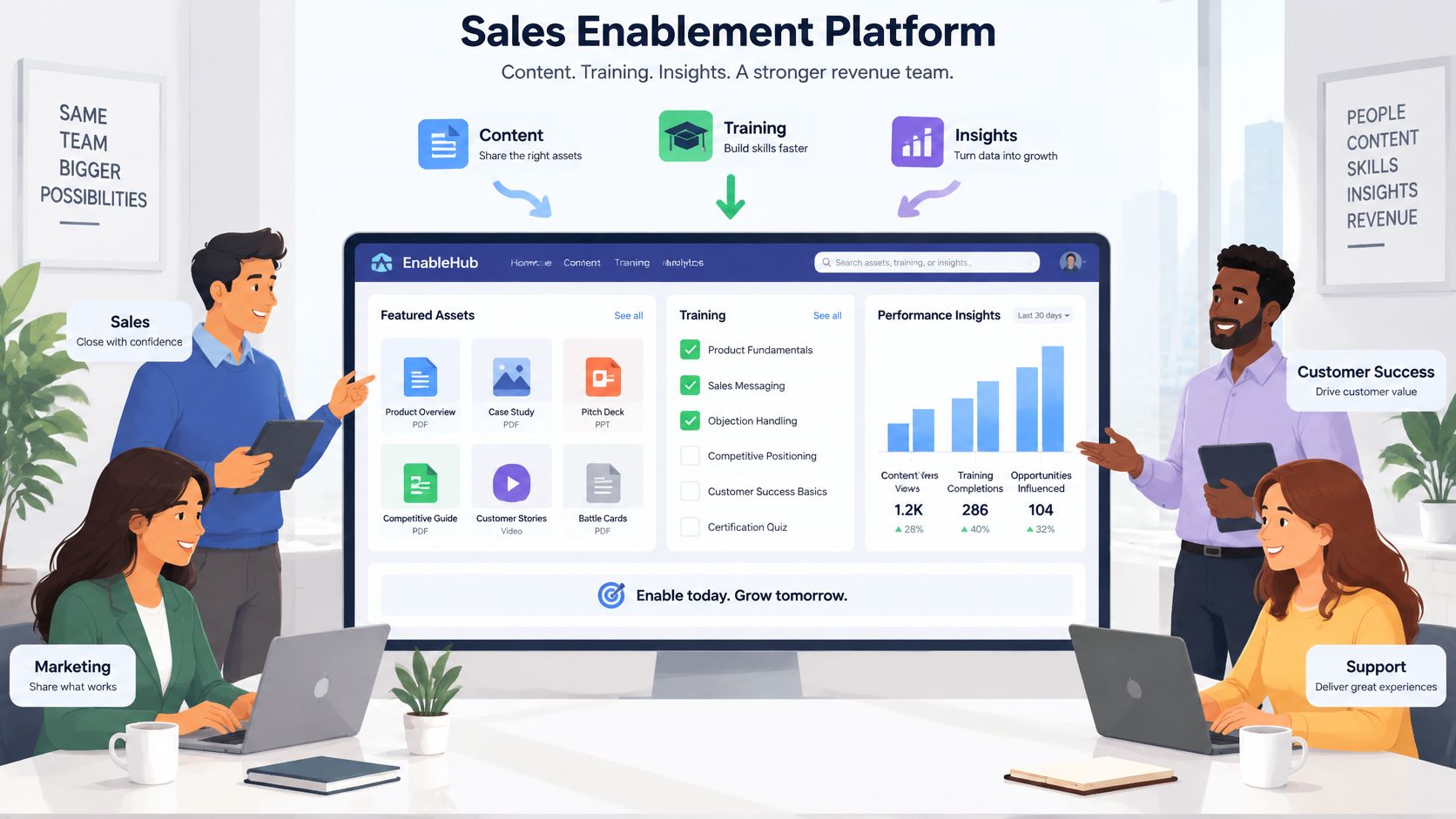
That history explains why today's products bundle content management, onboarding, coaching and analytics instead of shipping as document repositories. Buyers who expect a smarter shared drive end up paying for a system nobody opens.
Three tools get confused constantly, so separate them early:
- A shared drive holds files. It has no idea which deck is current, who used it, or whether a buyer ever opened it.
- A learning management system holds courses. It can onboard a hire and track completion, but it won't put the right case study in front of a rep mid-deal.
- A sales enablement platform ties assets, training and coaching to the seller's daily workflow, ideally inside the CRM the rep already has open all day.
Before shortlisting anything, list the three tasks where reps lose the most time this month. Finding the latest asset, preparing for a first call, and getting feedback on a pitch are the usual suspects. Then check whether each candidate platform addresses those three, and ignore the rest of the demo.
Core Capabilities and What to Verify in Each
A rep has eight minutes before a first call and needs this quarter's security deck, not last year's PDF. If search returns a pile of versions, you bought a filing cabinet with a login.
Seven capabilities carry a modern platform. Treat each row as a check you can run in a demo, not as a feature name to collect.
| Capability | What It Does | What to Verify |
|---|---|---|
| Content management | Stores, tags and serves sales assets | Search speed, tagging rules, version control |
| Usage analytics | Shows which assets reps share and buyers open | Separates views from meaningful buyer engagement |
| Training and onboarding | Delivers courses, quizzes and ramp plans | Administrator effort to build paths, completion tracking |
| Coaching | Records calls and gives managers review tools | Recording consent rules, feedback workflow |
| Playbooks | Guides reps through each sales stage | Mapping to your own stage names |
| CRM integration | Keeps accounts, opportunities and activities in sync | Two-way sync, object mapping, sync latency |
| Analytics | Links enablement activity to pipeline results | Reports on win rate and cycle length by asset or course |
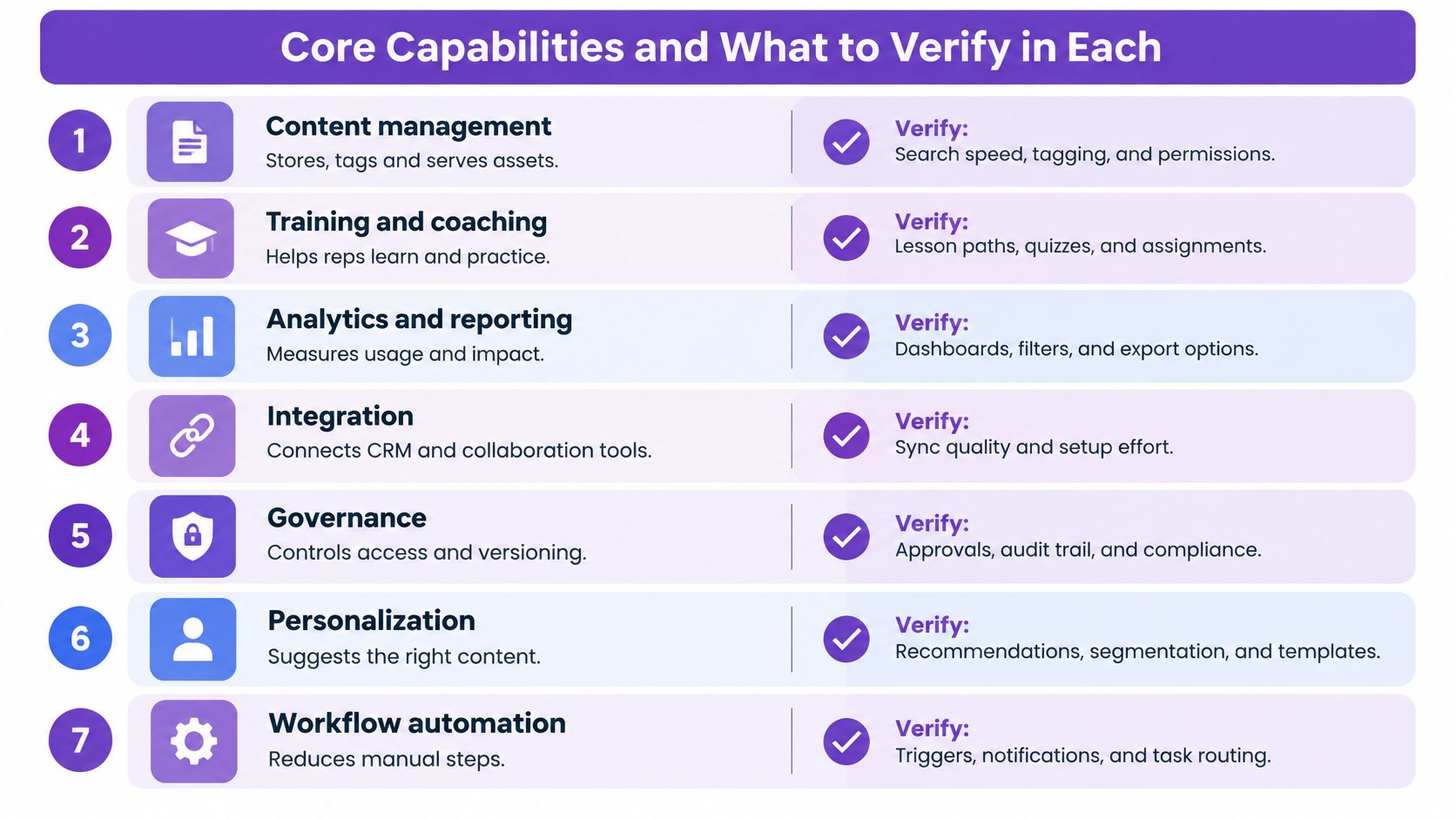
Content management fails on search, tags, and versions, not on how many gigabytes the vendor quotes. Usage analytics has to split a two-second glance from a buyer who forwarded a proposal. That split is what lets you connect an asset to a measurement you already trust, such as stage conversion.
Training paths look simple until an administrator spends days assembling one course. Ask how long a ramp plan takes to build, and whether completion is tracked per rep. Coaching is a recording plus a review queue. Confirm consent rules, then ask a manager to leave one comment and show where the rep sees it before the next call. If that queue stays closed, the module is shelfware.
Playbooks only work when the steps use your stage names. Request a screen mapped to your pipeline, not the vendor's sample stages.
CRM integration is the row that decides whether the other six show up on the account the rep already has open. Verify two-way sync, which objects map, and how long a change takes to appear. The analytics row should report win rate and cycle length by asset or course. A chart of logins does not answer whether the content moved a deal.
A compilation of sales content usage statistics reports that 53% of respondents said sales used fewer than half of their enablement materials. Enablement teams often describe a large share of the library as untouched. Volume is not adoption.
Practical rule: If a vendor's demo shows a library with thousands of assets, ask how many were opened by a buyer in the last 90 days. The answer tells you more than the feature list.
Outbound sequencing is a neighboring job. The sales engagement platform ranking covers the tools that sit next to enablement when reps also need sequences.
Score the seven capabilities against the workflows reps run, then drop the rows nobody will use. Four strong modules beat seven weak ones. The license is the small number on the quote. Tagging time, manager review time, and the work of tying activity to pipeline decide whether the platform stays in the day.
How the Platform Connects to Your CRM
Integration is where enablement either becomes invisible infrastructure or turns into a second system reps resent. The benchmark here is unflattering: a 2021 sales enablement benchmark found that only 35% of respondents considered their sales-enablement technology stack very well integrated, with disconnected systems named as a major source of workflow friction.
The cause-and-effect chain is worth following because it explains why integration quality predicts adoption:
- CRM-connected enablement data cuts manual searching and duplicate data entry.
- Lower administrative effort raises the share of reps who use the tool at all.
- Higher adoption produces fuller activity and engagement telemetry.
- That telemetry lets revenue teams connect assets, plays and training to pipeline movement.
Break the first link and the rest collapse. A rep who has to open a separate portal, log in again and copy an account name by hand will stop doing it by week four.
In practice, a well-connected platform means a rep opens an account record and sees the case study matching the buyer's industry, the last training module completed, and the engagement history on a proposal sent last week, all without leaving the CRM.
Practical rule: Judge integration by the percentage of target workflows a rep can finish without switching tabs, and by sync latency. Connector counts are marketing.
The pre-purchase checklist is short and specific: two-way sync, object-level mapping for accounts, opportunities, contacts and activities, single sign-on, role-based permissions, API or webhook access, and reports that separate content views from meaningful buyer engagement. Run a trial with real records and time the sync. If your team has no CRM, or a light one, ask whether the platform stores its own pipeline data and whether that data exports cleanly, because switching systems later is when lock-in bites. Buyers still choosing a system of record should start with a guide to choosing a CRM before evaluating enablement on top of it.
Market Size and Adoption Among Smaller Teams
Published estimates of this market disagree by a factor of two, and the disagreement is about scope rather than arithmetic. Each figure below belongs to the publisher that produced it.
| Publisher | Market Definition | Base Value | Forecast |
|---|---|---|---|
| Value Market Research | Global sales-enablement software | $4.65 billion (2025) | $24.65 billion by 2034, 20.36% CAGR |
| Grand View Research | Sales-enablement platform | $6.0 billion (2025) | $21.2 billion by 2033, 17.3% CAGR from 2026 to 2033 |
| Emergen Research | Global sales enablement platform | USD 2.8 billion (2024) | USD 8.7 billion by 2034 |
| Global Market Insights | Global sales enablement platform | USD 2.4 billion (2024) | 12.3% CAGR from 2025 to 2034 |
Value Market Research measures sales-enablement software specifically and puts it at $4.65 billion in 2025, rising to $24.65 billion by 2034 at a 20.36% compound annual growth rate. Grand View Research, cited in the same analysis, measured the broader platform category at $6.0 billion in 2025 and projects $21.2 billion by 2033 at 17.3% from 2026 to 2033.
Emergen Research puts the platform market at USD 2.8 billion in 2024 and USD 8.7 billion by 2034. Global Market Insights puts the same category at USD 2.4 billion in 2024 with a 12.3% compound annual growth rate from 2025 to 2034. Treat every one of these as an estimate tied to its publisher's definition, not as a settled industry number.
Adoption is far more lopsided than the growth curves suggest. Technavio's 2025 market analysis reports that more than 80% of large enterprises had adopted sales-enablement platforms, compared with fewer than 50% of small and midsize businesses.
That gap is not a verdict on smaller teams. A 20-person sales organization with one operations generalist doesn't need the governance depth a regulated enterprise needs, and shouldn't pay for it. The useful question is whether the vendor's implementation model, integrations and contract structure fit a team with no dedicated enablement operations group.
Ask for a smaller starting package: fewer modules, a shorter implementation, and a contract that doesn't require a professional services engagement to reach first value. Use market size to judge the category's momentum. Use adoption patterns and fit to judge your own case.
Hidden Costs and Measurement Burden
A finance lead signs a platform quote. Six months later the operations generalist is still reconciling deal stages by hand. The license looked like the decision. It was the smallest line in the budget.
The 2025 State of Sales Enablement report/State%20of%20Sales%20Enablement%20Report%20-%20Final.pdf) shows why the money runs out before the value arrives: 27% of respondents struggled to consolidate data from disparate systems, 25% cited budget constraints, and 18% said they could not effectively measure sales performance.
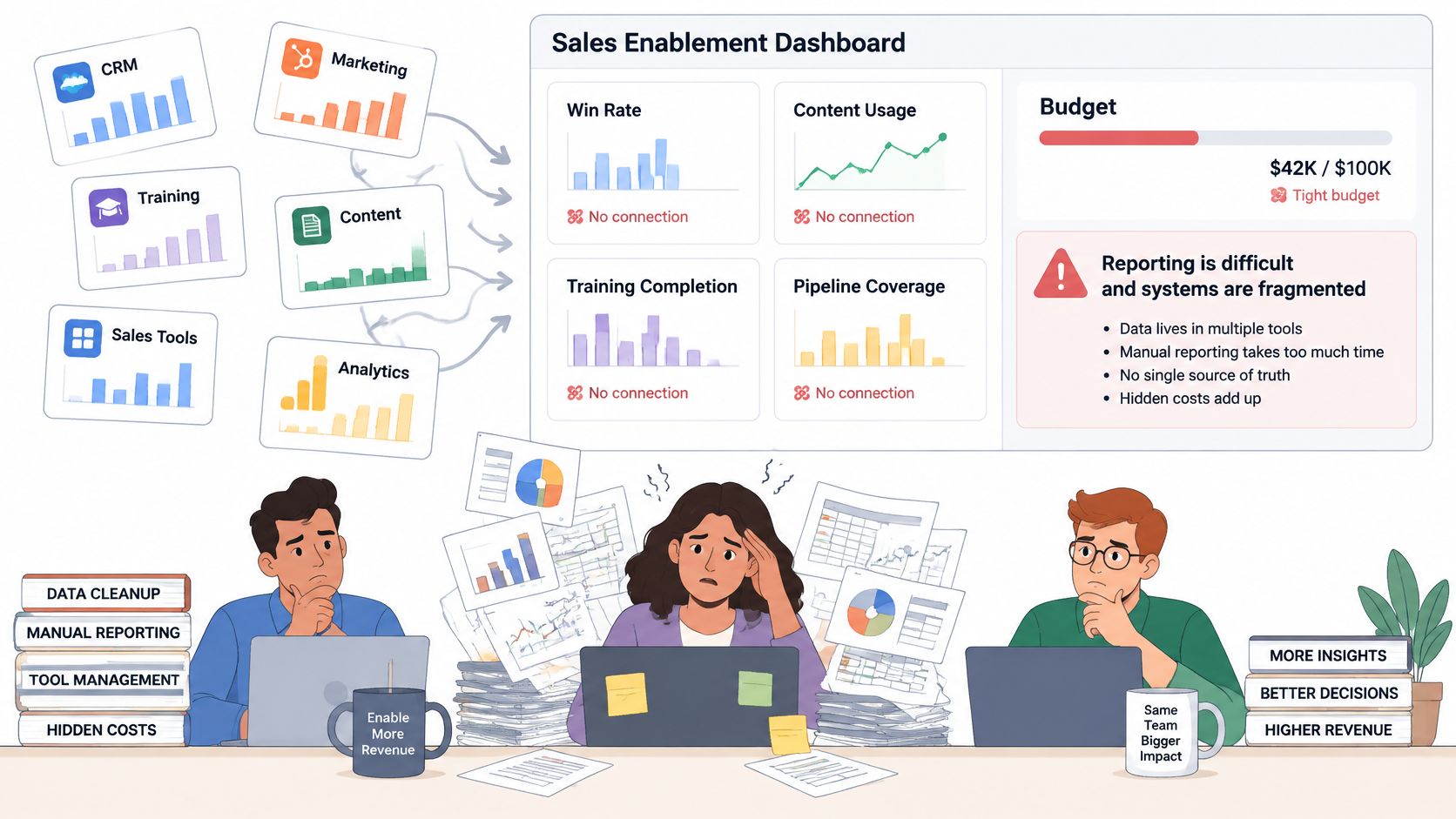
Applying AI to the process you already run often yields only small productivity gains. New bottlenecks appear, and sales data stays fragmented and poorly governed. Fix data quality before you expect an assistant to change results. A vendor case study from a large enterprise sales floor also does not transfer to a 20-person team with a light CRM, inconsistent opportunity stages, and no enablement operations function.
Build the total-cost model before the trial, not after. It covers data cleanup, CRM and conversation-intelligence integration, content migration, administrator hours, training, governance, and ongoing measurement. Most of those hours land on people you already employ, which is why they disappear from vendor comparisons. Treat the platform as an operating layer: it has to share one pipeline definition with the CRM, and someone has to keep the measures current or the license sits unused.
Then separate what you can watch from what you can only hope for.
Leading indicators move within a quarter and show whether the platform is being used: content reuse, ramp time for new hires, and manager coaching completion.
Commercial outcomes move slowly and get credited to a dozen other changes: win rate, cycle length, and revenue per seller.
Readiness test: Can you say where deal stages are defined, who owns each piece of content, and which system is the source of truth for pipeline? If any answer is unclear, fix the data before buying software.
The purchase turns on whether your organization can show what enablement changed without building another reporting layer on top of the one you already cannot maintain.
Does Your Platform Need an AI Answer
Short answer: an AI layer isn't a buying requirement today, but it is becoming one for any team whose buyers research before they call. A platform that only automates seller tasks is being judged against a target that moves every quarter.
Two signals frame the shift. Gartner's sales AI research projects that 95% of seller research workflows will begin with AI by 2027, up from less than 20% in 2024. HubSpot's 2025 international survey, reported on the same Gartner page, found that 74% of sellers believe AI makes it easier for buyers to research products, while 37% of deals fail because buyers do not see product fit.
That second number is the interesting one. Buyers arriving pre-researched don't need a product overview. They need proof of fit, and they need it before a rep gets a meeting.
Three checks work on any platform you're evaluating:
- Machine-readable content. Can the platform serve approved proof points in a form an AI assistant can read and cite, or is everything locked in a slide deck?
- Signals before the first call. Do engagement events reach the rep ahead of the conversation, or only appear in a dashboard the rep never opens?
- Fit, not answers. Does the platform help a rep diagnose why this buyer's situation matches the product, which is different from answering a feature question faster.
The counterweight is worth holding onto. Applying AI on top of messy process and fragmented data tends to produce small productivity gains and fresh bottlenecks, not transformation. Treat AI features as an addition to workflow and data quality, not a substitute for either.
Ask vendors to show the AI capabilities running in production at a customer, with the workflow they replaced. Roadmap slides are cheap.
How to Evaluate a Platform in Five Steps
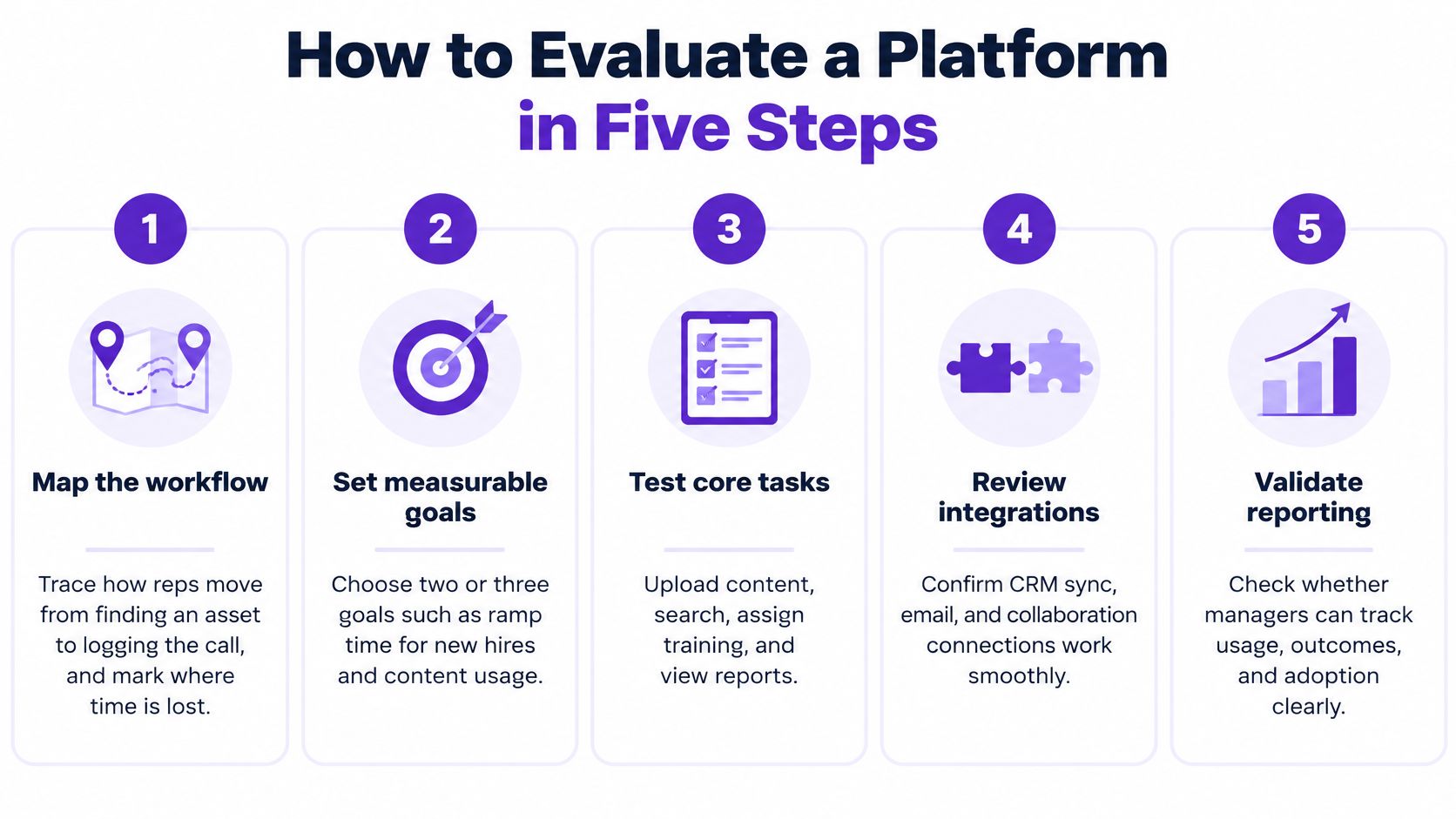
1. Map the workflow your reps follow today. Trace the path from "I need an asset" to "the call is logged in the CRM" and mark every point where time disappears. Skipping this step is the most common mistake in the category, because it produces a purchase built around the vendor's demo instead of your Tuesday.
2. Set two or three goals you can measure. Ramp time for new hires, content reuse rate and manager coaching completion are the three that move first. Pick no more than three, write down the current number for each, and refuse to add a fourth.
3. Shortlist three platforms at most. Compare documented features and published prices side by side, and note the vendor and the date each price was checked, because contract values shift with seat counts and add-on modules. Three is enough to expose differences. Ten produces a spreadsheet nobody reads.
4. Run a trial with real assets and real CRM records. Load your own decks, connect a sandbox, and let the people who will use the tool daily drive it for one full deal cycle of your own. Buyers who skip the trial end up trusting a scripted demo over their own reps.
5. Score features, ease of use and total cost, including administrator hours and content migration. Then pick the product that wins on your workflow rather than the one with the longest feature list. The platform with fewer modules that reps open is the better buy.
What a good trial looks like: reps finish a task without asking for help, managers review coaching inside the tool rather than in a side spreadsheet, and the CRM records match what reps entered.
Confirm the Fit Before You Choose a Platform
Match the platform to the largest workflow gap. If reps can't find content, prioritize search, tagging and usage analytics. If managers can't coach, prioritize recording and review tools. If nobody can connect pipeline results to enablement activity, prioritize CRM sync and analytics.
KeenVerdict compares documented features, vendor documentation and published prices rather than running hands-on tests, so a shortlist is a starting point and a trial is the proof. The research desk has also published a Sales Productivity Statistics 2026 page with 48 figures from 18 sources, updated on November 4, 2026, for anyone who wants the wider numbers behind the category.
Write down the three workflow gaps your reps face this quarter. Shortlist up to three platforms against them. Run the five-step trial with real content and live CRM records, and record every result in one scorecard before you sign. If a vendor won't support that process, that answer is the evaluation.
Cite this page
KeenVerdict. Sales Enablement Platform Guide: What to Buy and Why. Updated November 28, 2026. https://keenverdict.com/sales-enablement-platform
Questions or corrections: editorial@keenverdict.com